Wednesday, 9 November 2016

The Ritual of Vengeance: Welsh blogger Jacqui Thompson fights for her home


If in the ritual
Of vengeance he live,
He makes perpetual
His failure to forgive.
No; to those arbiters
Of true behaviour
There is no strength but stirs
To honour its saviour.

Vernon Watkins


One of the more complex stories covered by this blog, over the course of the past few years, is a still continuing saga about another blogger; a Welsh woman named Jacqui Thompson, who writes under the name of 'Caebrwyn' - also the name of the isolated spot where she lives, in rural Carmarthenshire, and where her husband Kerry makes his living as a forestry worker.

A small, middle aged woman, quiet, and modest, yet fiercely intelligent, and brave: her blog has been outspoken in its coverage - and criticism - of the activities of Carmarthenshire County Council, including the behaviour of the county council's Chief Executive, Mr Mark James.

Mr James is now one of the most highly paid Chief Executives of any Welsh authority, earning around £185,000 per annum, but he started off, funnily enough, as a rather more lowly officer for ... the London Borough of Broken Barnet. There could be no better preparation for the career of any Chief Executive, of course.

The long running tale of the fight between Mark James and Jacqui Thompson first came to the attention of the media about five years ago, when, in a most extraordinary act, the Chief Executive had Mrs Thompson arrested in the public gallery of the county hall during a council meeting - simply because she was filming a few minutes of the proceedings on her phone. Jacqui was taken away in handcuffs, and kept in custody, in a police cell, for several hours, as a result of this innocuous, and perfectly lawful act.


Arrested for filming a council meeting on her phone ... pic credit Alex Murray Smith

By any standard of measurement, such ludicrous treatment was utterly unnecessary, but it was all the more shocking at a time when the idea of citizen journalism was beginning to meet with approval from the government, and promoted by no less than Eric Pickles, who wanted to encourage the scrutiny of local government by its electorate, and hoped that it would enable residents and taxpayers to hold their elected representatives to account.

Mark James, of course, was not, and is not, an elected representative, but the servant of that electorate and their representatives: an administrator. Yet he wields a power that is far beyond that of most Chief Executives, and enjoys a wide scope of influence within the process of governance in Carmarthenshire - and beyond.

To understand the background to this event, and the battle between Mark James and Jacqui Thompson, it is necessary to note that the early genesis of her blogging career came, as did many others, from a personal issue, and a sense of injustice over the handling of that issue, in this case by her local planning authority.

Caebrwyn's award winning blog, although it now covers a wide range of political matters in Carmarthenshire, still bears the title: 'Carmarthenshire Planning Problems, and more' ... and as explained so well in this piece published in the West Wales Review,by Patricia Dodd Racher, originated from a sequence of unsuccessful planning applications handled by the local authority.

Mrs Thompson was not the only person to have raised serious questions about the local planning department, as I reported from the later libel hearing in the High Court which occurred as a consequence of the #daftarrest incident, as it became known.

On the fourth day of the case, Jacqui's counsel asked:

"What about the action of local MP  Jonathan Edwards, calling for the Audit Commission to look into the planning department at Carmarthenshire County Council, the very same department that Mrs Thompson was so concerned about?

I'm sorry, said Mr James. I can't recall."


And as I also reported at the time, the case attracted a lot of attention in the national media:

"Legal blogger David Allen Green has described the judgement as being, in his view, 'illiberal', and Mrs Angry would have to agree. 

Nick Cohen remarked on twitter:


In democracies the public holds the govt to account, not the other way round. In Britain however.. #daftarrest bbc.co.uk/news/uk-wales-… …


Campaigning journalist Heather Brooke commented on twitter:


 So @caebrwyn loses #daftarrest libel trial. Judge didn't seem to have a lot of time for her or her arguments so not totally surprised."

There was also a leader in the Times, on the last day of the trial, 20th February 2013, which was highly critical of Carmarthenshire County Council, accusing it of wielding 'excessive official and financial power against a lone citizen' and becoming a case study in how not to behave in an era of transparency and accountability': 


The reference to the Derbyshire judgment would seem to be significant, one would think - but this argument ultimately failed, despite the evidence offered that Jacqui Thompson's criticism of James was part of a wider and reasonable act of scrutiny of the council's activities.

In a second article in the 'West Wales Review', there are examples given of what are described as 'planning contradictions which have perplexed applicants and the public'.

Since Caebrwyn's blog was founded, it has grown in scope and depth of scrutiny, and covered many local issues, posing questions that may not be welcomed by Mr James or his employers at Carmarthenshire County Council, but which address issues and concerns that are most certainly in the public interest, such as the council's relationship with the local Scarlets' rugby team - and the curious tale of the evangelical bowling alley, to name but two.


Blogger 'Caebrwyn' - Jacqui Thompson ... pic credit SW Guardian

Among the outspoken critics of this local authority, perhaps rather surprisingly, we find the former Former Dyfed-Powys Police and Crime Commissioner Christopher Salmon, who is quoted in an article published this May in the South Wales Evening Post as comparing the council to a 'Sicilian cartel':

"... looking back at his time as commissioner, Mr Salmon said he wouldn't miss "online bores", Carmarthenshire Council and the "police mob".

After describing the local authority as a cartel, he added: "It's everywhere you look (thankfully only in Carmarthenshire – so far as I can tell).


"It extracts vast amounts of money from residents which it showers on favourites, hordes property, bullies opponents, co-opts friends and answers to no one, least of all local councillors."


After Mr James had had Jacqui Thompson arrested for using her phone in the public gallery, events had taken a rather unexpected direction: beginning with a completely unexpected move by Mr James, as explained by her fellow Carmarthenshire blogger, the masterly Cneifiwr, who has written a incisive post on the story here, and reminds us of the beginning of the libel action:

It is worth remembering that following the arrest, Mr James, the most senior officer in a local authority, took the extraordinary step of posting his thoughts on the Mad Axeman blog, written by someone who lives not in Wales but the north of England, and that it was those incendiary comments, attacking not just Jacqui but her entire family, which triggered the libel case.

Is it normal for council chief executives to attack a family living in his or her local authority area on a blog in their capacity as Head of Paid Service? It is a reasonable bet that Mr James is the only one ever to have done so, just as he was the only council chief executive ever to persuade his council to adopt an (unlawful) libel indemnity clause in its constitution allowing him to pay for his counter-claim using council funds ...


Yes: quite why James saw fit to make such remarks, is unclear, but this led Jacqui Thompson to feel she had no option but to take legal action to defend the reputation of herself and her family. James, backed up by the council's indemnity, was able to take a counter claim: after an astonishingly condemnatory verdict from Judge Tugendhat, acting on his own, rather than, as expected, the hearing being held before a jury, James won, Jacqui lost, and three years later, is now being pursued by him for the damages awarded. 


Mark James after his successful hearing at the High Court

As you may read here, at the libel hearing Mr James was not able to recall the details of a meeting at which the report approving the indemnity, later found to be unlawful by the Welsh Audit Office, was discussed, in his presence, as an emergency item.

Mark James is now determined to obtain the money awarded to him as a result of this council funded counter claim: due to an 8% interest rate, this now stands at £35,000. But Jacqui is also being pursued for costs by Carmarthenshire County Council, of £190,000. 

This story has now been picked up by the Rotten Boroughs' column in the new Private Eye:


Jacqui Thompson cannot pay either of these amounts, so a charge has been put on her home by the council - and Mr James will expect to receive his share of any capital accruing from the sale, should it be allowed, even though the action he took in the first place was unlawfully funded by his employers. As Cneifiwr has pointed out, there appears to be a lack of clarity as to whether or not the money James extracts from Mrs Thompson should be returned to the council, or whether he will keep the money himself.

Apart from the terrible financial punishment now being executed in the courts, this year has seen further attempts at action against Mrs Thompson by Mr James.

In April, she was informed that he wanted to return to the High Court and begin proceedings against her for contempt of court, and that he had referred matters to the local police, asking them, as she explained, to conduct an investigation 'with a view to considering criminal prosecution for harassment, relating to the blog'.

On the 12th July she was also told that an additional criminal allegation of perverting the course of justice had been made against her 'at some point', and that officers were investigating this as well. Months of anxiety passed, yet the police made no contact. She was left almost completely in the dark about the enquiries that were continuing, and had no way of defending herself from whatever allegations were being considered. 


Carmarthenshire County Council CEO, Mark James

In August, Matthew Paul, a barrister - and sometime local Conservative candidate - spoke out against this investigation in an opinion piece in the Carmarthenshire Herald, in no uncertain terms: denouncing the whole process, the lack of legal basis, and the apparent motives behind it. He pointed out that Mr James had himself been the subject of police enquiries, in 2014, (along with the Pembrokeshire CEO, over a matter of cash payments in lieu of employer pension contributions) but Dyfed-Powys police had passed the investigation over to Gloucestershire Constabulary 'like a primed grenade', because of  'the close working relationships and partnership arrangements that existed between Dyfed-Powys Police and Carmarthenshire Council'. This made it 'not appropriate for the local force to carry out the enquiry'.
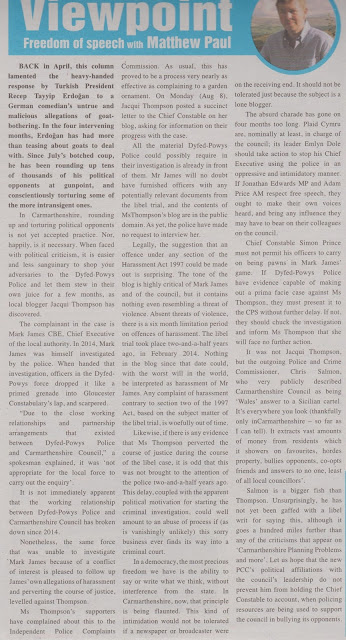


Mr Paul commented that the relationship between the local police and council appeared not to have broken down since 2014, yet it was still able then to investigate James's own allegations in regard to Mrs Thompson. He also observed that in his view, 'with the worst will in the world', nothing published by her could be interpreted as harassment. On the 18th August, however, although the investigation into perverting the course of justice was dropped, Jacqui Thompson was issued with a Police Warning Notice in regard to the alleged harassment. She has tried to complaint about this, unsuccessfully. But then, as she commented at the time:

As this is not a legal notice nor a caution, there is no direct way to appeal it, or defend myself.

Matthew Paul is quoted in the Eye piece this week:

The high court's judgment (and that of the court of appeal) in Thompson v James was badly wrong. It would have been entirely possible to find that neither party had libelled the other, and that the case was an immense waste of court  time and public money.

It should be noted, incidentally, that the unsuccessful appeal, in April 2014, was only allowed on one ground, that of the infamous 'slush fund' suggestion.

It had taken four and a half months for Jacqui to receive a visit from two officers from Dyfed-Powys police, to tell her that the allegation of perverting the course of justice had been dropped, as the evidential test was not met. As she commented in her blog: 

As I suspected, this criminal complaint, which was also made by Carmarthenshire Council chief executive Mr James, related to the libel judgement of High Court judge, Justice Tugendhat, in March 2013.

The judge, in 2013, made this finding on a balance of probabilities, and in a civil court. 

The finding was simply a matter of whom the judge decided to believe, she said, and she believed it was a total miscarriage of justice, which led to the withdrawal of her legal insurance and led to the huge burden of costs she now faces.

Matthew Paul also raises the question of the former Police Commissioner's remarks about Sicilian cartels being left unchallenged, while Mrs Thompson's satirical allusions to 'Pinocchio', and 'slush funds' in regard to the council's unlawful indemnity were found to be libellous. The difference, presumably, is that the cartel remark was not made in regard to an individual officer, and therefore the Derbyshire judgment would prevent any action.

The blogger Cneifiwr has written about the political background to the Mark James - Jacqui Thompson story, and explained the way in which the absence of strong leadership in Carmarthenshire has led to a greater share of power resting in the hands of a chief executive. 

With the honourable exception of the courageous and independently minded Councillor Sian Caiach, almost no other councillor in Carmarthenshire has dared to provide any form of effective challenge to the status quo. Sian Caiach continues to express her criticism of the current regime, as you may read here. And read this post from 2014, on her attempts to question the issue of the unlawful indemnity:

http://wwwbrokenbarnet.blogspot.co.uk/2014/02/strapped-to-wheel-yet-they-shall-not.html

Cneifiwr also points out that the continuing publicity emerging from the Mark James/Jacqui Thompson story is doing nothing but damage to the reputation of the council, and that the impact on the forthcoming elections next year will be incalculable. And what will have been achieved?


The only small consolations for the rest us are that he will ultimately fail to silence his critics, and that the libel saga, meant to protect his reputation, has had the opposite effect.

As Matthew Paul remarked in August:

In a democracy, the most precious freedom we have is the ability to say or write what we think, without interference from the state. 

In Carmarthenshire, it would appear, that principle is one that is held in little respect. And as the Private Eye piece says, the price is being paid by Jacqui Thompson. The use of the legal process, the courts and the police, to pursue and punish this woman, and drive her from her home, may be possible in law, but to most observers it appears both disproportionate, and unfair. 

Mr Mark James is apparently a man of strong Christian values: it might be timely for him to demonstrate that the tenets of that faith include the obligation to forgive our enemies their trespasses, and to call a halt to his pursuit of the damages: the case was won, his reputation was vindicated; and there is nothing further to be achieved, and only more unwelcome publicity for him, and his employers, by pursuing the legal process to secure this money - from someone who simply does not have it. 

Failing that, it may at least occur to those politicians - and any others who may bring their influence to bear on this sorry business - that now is the time to act, and intervene on behalf of all parties: before it is too late.


Sunday, 6 November 2016

Remember, remember: the 5th November march for libraries


Barnet Unison Library convenor Hugh Jordan addresses the libraries demo

Yesterday saw a march in London on behalf of campaigners fighting to defend the foundations of our cultural life from death by a thousand cuts: museums, galleries - and most of all libraries.

The library, for so many writers, artists, academics, is where it all began, or at least for so many writers, artists, and academics from less affluent backgrounds, whose only access to education, beyond their school life, was from their local public library.

At the demo were several eminent children's writers, including the Children's Laureate, Chris Riddell, Phillip Ardagh, Alan Gibbons, and Michael Rosen. Michael spoke about the 'emancipation' of his parents, living in the East End, by their use of Whitechapel Library, and the Bethnal Green Museum, and he deplored the fact that similar access was being taken away from those who need it now.

Nothing has changed, from the days when Mr and Mrs Rosen depended on their local library and gallery in order to have a life enriched by literature, or art. Even in our grossly materialistic society, money cannot buy the pleasure and benefits that they bring. Yet our Tory politicians think that downloading a book or an image on a laptop, or kindle, creating virtual and remote ownership of a borrowed idea, or picture, can be an adequate substitute - preferably generating profit somewhere for someone. If the disadvantaged citizen is excluded from this activity: hard luck.


We didn't have many books in our house, when I was a child. 

Or rather, we didn't own many books: yet reading was for all of us, in our different ways, central to our lives - a refuge, an escape, and a passage to another world - different worlds, as many different worlds as the library could provide us with, for our own needs, parallel, and yet separate to each other, in our semi-detached, suburban isolation. 

Semi detached, emotionally as well as literally: a home where words were read, not spoken, and thoughts kept to ourselves, for fear of the exposure they might make, an admission of feelings best left unacknowledged, the dangerous thoughts of a household unsure of its position, aspiring to a place of middle class respectability, behind the privet hedges, in the pink blossomed, cherry tree lined avenues of Edgware.

My parents were both self educated; intelligent and thoughtful, forced to leave education in their early teens, my mother resentful all her life for the missed opportunity of the grammar school place she had won, but had had to refuse, as her impoverished family, struggling to survive on my grandfather's miner's wage, could not afford the expense of uniform, bus fares and all the other extra costs that this would have involved. The sort of hidden barrier which would seem to have returned in this age of inequality of access to education. She spent much of her time reading historical fiction, usually the better sort of bodice ripping romantic sagas that came in endless series, like Catherine Cookson, who wrote about the North East, and the close knit working class background she was obliged to leave behind, on marriage, and was disappearing, rapidly, in the post industrial era of my early childhood. 

And my father had left school at fourteen, a bright and determined child from south London, who found a job as an office boy in the City, and worked his way to a directorship, on merit, at a time when promotion was entirely dependent on a public school background, and a network of patronage. He took me to the library, every Saturday morning, and while he chose his own books, left me to my own devices, from the age of four or five, in the junior section, lost in the bookshelves, without a moment's doubt that I was safe, in a a nurturing environment, full of wonderful things to read, and to choose to take home. An experience made all the more more precious by the fact we were allowed to borrow only three books at a time. My father would usually borrow the sort of naval historical fiction written by Alexander Kent, acutely aware he was the first generation of his West country family not to go to sea, but fascinated to explore, from the safety of his landlocked life, what might have been, should have been his life, if things had been different.


Being at an age now when I can't remember any more pin numbers, or passwords, or what was on my missing shopping list, I am still cursed with a clarity of recall for the most trivial detail of my early life, and still can list many of the books I read as a child - can see them still: the covers, the illustrations; where they were to be found on the shelves.

The very first book I had, however, was a rag book, which I used to have in my cot, a sort of painted prison in which I seem to have been kept for hours at a time, even in day time - and which I can still remember climbing out of, out of boredom, when a toddler. 

The first proper book I had then, still in captivity in the cot, was one with pictures of dimple cheeked babies, illustrated by Mabel Lucie Atwell: did my mother read it to me?  I doubt it. She wasn't the sort of mother that snuggled up and read to her children, or at least to me: she would always say she was too busy. In fact that was so rare an event I can remember what seems now like the only occasion, a speedy and rather grudging indulgence, her resignedly reading one of my books to me, on a Saturday evening, me perched awkwardly on one of our horribly uncomfortable armchairs, designed, as they were then, for endurance rather than comfort. Well chosen, for our house. Neither of us were keen to repeat the experience.

Of the few other children's books in the house, there was one with which I developed something of an obsession, a Noddy annual, discarded by my older brother, with pictures coloured in the most alluring tones of bright pink, and red, acid yellow, green and blue, illustrating a realm of stories from which I was cruelly excluded, by my lack of literacy. 


No one would read them to me, so I resolved then to learn how to do it myself, and was reading before I went to school, aged four. School was a great disappointment, in fact, obliged as we were then to read out loud the interminably dull tales of Janet and John, and not annoy the teacher by outreaching the limitations of their strictly regulated vocabulary. 

Thank God, then, for the new library, in Edgware, and its fabulous children's section, developed in line with the vision of Eileen Colwell, the pioneering librarian: a haven with endless oak lined shelves of books to discover. 

I can still recall the shape and feel of the metal door handle, shaped like the burnished wing of a modernist era angel, which a child's fingers must firmly grasp, before pushing, with no little effort, on the heavy, unyielding door, to enter the room. It seemed appropriate, to be obliged to make that effort to gain entry to the privileged world of books waiting for you inside.

There was the counter, on the left hand side, at which you would stand, rather hesitantly, hoping not to have to engage with the fearsome librarian, whose fingers ran so lightly through the cardboard tickets kept in long, narrow wooden boxes. If you were foolish enough to bring back a book later than the three week limit: the shame would be too much to bear. But you would at least have the great pleasure of putting your fines in the brass edged slot in the counter, and listen to the coins roll down with a satisfying clunk, into the box below. My books were never overdue, as I was so desperate to exchange them for new ones, so rather to my regret, I never did have the chance to try this out.

Not having any guidance - or interference - from parents was a blessing, in fact. I would choose books by a process of serendipitous illogicality, usually doing what we are advised not to, that is to say, to choose a book by its front cover, or its illustrations, tempted by, for example,  the beautifully coloured pages of Orlando, the Marmalade Cat, (definitely the reason I have a ginger and white cat of my own ...) 


Or anything, like the Nurse Matilda books, with cross-hatched pen and ink sketches by an artist whose style I quickly learned to recognise, Edward Ardizzone.

Folktales and legends, in Edgware Library, had their own bookshelves: on the wall to the right of the door as you entered: a wealth of cloth bound tomes of the sort you would never publish for children now, as they would be considered too long, and too complex. Series of tales from all around the world, and every culture, from the Greek and Roman myths, to those of Egypt, India, Africa, Scandinavia: Hans Christian Andersen, the brothers Grimm: introducing children to the range of archetypal themes that populate all cultures, and symbolise the human condition - giving an insight beyond the limitations of a child's own developing mind, into the realms of something more profound, and eternal.

Some books, and their sequels, were favoured because of the possibilities of freedom and adventure they offered: the Narnia series, one of many works of fiction which appealed, I suppose, to a child whose own parents were so authoritarian, because they were about children at large in a fantasy world, without adult supervision, independent, and powerful.

This was also partly the appeal of so many books set in boarding school: Malory Towers, the Chalet School - and even the Jennings books, an example of the necessarily secret cross gender reading of a girl of that period, running out of her own books, at the weekend, or on holiday, and forced, in desperation, to borrow her brother's, and learn what it was to be one of that other species, a boy: Jennings, Just William, Biggles -  Rider Haggard, and Captain Marryat, then HG Wells, Sherlock Holmes, and so many others.

Another favourite genre as a child was biography: especially those issued in the exemplary series, published by Max Parrish, telling the story of the young lives of famous figures - including an unusually high number of women - writers, artists, musicians, reformers; Elizabeth Fry, Mozart, the Brontes - Charles Dickens.

Curious, in retrospect, that so much of the fiction of childhood featured a young protagonist that was an orphan, or a child living apart from family - like Oliver Twist, or Jane Eyre, foundlings like the girls in Ballet Shoes; Anne of Avonlea, Heidi, and so many others. 

The cruelty of early life displayed in Dickens, and Charlotte Bronte, in Jane Eyre, especially resonated, for some reason: for a particular reason, being sent to a Catholic school, at the age of six, whose merciless regime seemed designed to break the spirit of every child left in its 'care', beyond the intervention of family, and parental protection, if that had been offered, which it was not.

Perhaps I identified with those orphaned characters, those children left in the world to fend for themselves, because the emotional distance within my own family had fractured my own sense of belonging; or perhaps it is an experience common to all children, that they must explore and develop their own sense of self, as they grow up.

Reading so widely, and learning the ability to recognise the same feelings, and to feel a common bond with other lives, is an invaluable process for all children: but perhaps more important is the recognition, and understanding of difference - to learn the process of empathy: to understand the feelings of others. This is only possible by the use of imagination, that step away from the world of your own experience to a world inhabited by someone else, where the rules you live by no longer apply, and everything familiar to you has changed. How will you manage? And how does the world appear to the person standing next to you, or in another country, or from a different culture?

One of the leading organisers of yesterday's march and demo was the children's writer Alan Gibbons, who has been to several library protests here in Barnet. He came to the occupied library, in Friern Barnet, and made a very interesting speech on the subject of the link between reading fiction and empathy. How many children -  or adults, he asked - who become involved in violence, and acts of hate crime, for example, lacked that vital stage in their development in which the experience of reading would have allowed a sense of empathy to become embedded in their minds, and prevented a fatal degree of emotional detachment, and alienation, and the establishment of anti-social behaviour - or worse? 

Well written fiction, biography, folktales, poetry and drama: all help to show the way: they navigate a path through the unknown, and teach you how to survive: they encourage the development of resilience, of emotional intelligence, as well as academic proficiency.

What a tragedy it is, then, that we have turned our backs on the defence of the public library system: that future generations of our children, and grandchildren, will grow up without this precious resource. 

Of course the children and grandchildren of those implementing the cull of libraries will not lose anything. 

The children and grandchildren of politicians whose own lack of empathy endorses a government agenda of unjust and illiberal social policies are unlikely to be encouraged to learn to enter the world of imagination, and connect with the lives of those different from and less fortunate than themselves. 

But the children of the poor, the disadvantaged: those who, for a century or more, benefited from the provision of free access to a public library, are seeing the destruction of that vital means to education and empowerment.

In Barnet, as elsewhere, the lifeline offered by public libraries is being remorselessly cut: the right of access to a public library, for many of the borough's least advantaged children, is about to end. That right, which we always thought had been enshrined in statute, in the Libraries act, will become meaningless as the Tory council implements its new programme of devastating cuts, hidden behind the lie of 'reshaping'. 

Children will be banned from the new open library system: a system imposed through sacking half of the library staff, and introducing the as yet untested concept - on this scale, and in this urban context - of completely unstaffed libraries. 


The children of East Finchley: barred from unstaffed libraries, supported by Labour AM Andrew Dismore

Banned from the new DIY libraries, but if they manage to find a staffed library where they can borrow books, (or study), should they have problems returning them on time, perhaps because they live a long way from a staffed branch - their Tory councillors have reintroduced the idea of fines for children's overdue books, in order to generate income. And perhaps to deter children from borrowing them in the first place, which will in turn  lower attendance levels, and give the council more ammunition in the argument for shutting libraries. All utterly cynical: and very clever.

The truth is that the Conservative administration in Barnet has been deliberately running down our once exemplary library service - one awarded beacon status, and recognised for its value for money performance. The staffing structure has been cut, again and again, with a motive of de-professionalisation, and a deliberate abandonment of standards in service. The stock has been culled, and cut. The loss of specialist librarians for children, and information, has become evident in stock selection and the overall management of the libraries.

As part of the latest, most grievous assault on Barnet libraries, senior officers, from the council and Crapita, provided a series of pointless 'information sessions' about the new cuts, in which the exchange of information was diverted down a one way street. Residents were told how the 'reshaping' of their libraries would begin. There was no time for debate over the decision. There never was any possibility of choice. 

The libraries will become libraries in name only: buildings with a nominal library function, the buildings now given over to Capita to run. The carving up of space, and the loss of library functions within these buildings is about to be enacted: nothing will ever be the same.

I attended one of these sessions at North Finchley, and was appalled by what they are planning to do to the beautiful, purpose built library. The children's library at the front, designed with curved, low windows especially for the use of young readers, is to be emptied of its purpose, the children removed from their own designated safe space, and the rooms given over for renting to businesses.

Except of course, that excuse is nonsense. When questioned, the senior officers happily waved away any concerns about the lack of demand for such office space. It didn't matter, the lack of any business plan, or even the lack of any revenue from such fantasy rental options: the library budget, newly slashed, would not be affected. Why not? It seems because in fact the council is going to use the space itself. Will Capita earn income from renting the space to other council services? We don't know: but we do know Capita does nothing without charging a fee.

Looking at the children's library, about to be destroyed, was overwhelmingly sad, just as it is to visit the children's library in Golders Green, where I once worked: where bookshelves used to be overflowing, now there are many gaps, and empty shelves, and a dearth of variety or choice. 

So sad, all of this, because of the terrible injustice of what they are doing: but sad also because the children's libraries have been allowed to deteriorate to such an extent from the standard set by Eileen Colwell, all those years ago. A few paperbacks on sparsely populated shelves, in a run down room, with peeling paint, and a sense of decay, and a loss of spirit. We lost our libraries a long time ago: and we will never reclaim them, until there is a political will to recognise the value of reading, the value of access to information, supported by qualified staff: the need for quiet, safe spaces for children, the elderly, the less advantaged members of our community.

In a borough where the political administration abhors the very principle of public services, which refuses to acknowledge the idea of community, there is little hope of any long term future for our libraries. 

Unless, that is, we rise to their defence. 


Barnet library strikers before the march

Yesterday many Barnet council library workers, campaigners, residents, union members and Labour councillors marched through London, to show their support for our libraries. Many of the staff members present face the loss of their jobs, and many of the residents the loss of their libraries. 

During yesterday's march, I had the great pleasure of walking alongside a woman called Megan Charlton, from Durham: one of the spokeswomen for the 'Durham Lions' - a group of magnificent women from the North East, teaching assistants fighting the loss of a massive slice of their pay, in what appears to be a grossly unfair and arguably discriminatory cut by the local county council. 


Durham Lion & TA representative Megan Charlton meets Barnet's People's Mayor, Mr Shepherd

Fortunately the support they feel has been missing from the local Labour establishment, and the leadership of Unison, has been found elsewhere, including from the Durham Miners Association, whose late and much missed president Davy Hopper came to support a library march in Barnet, along with representatives of the fabulous LGSM.

No coincidence that Durham produces such strong women, like the indomitable women in my family, whose fighting spirit continues in a new generation, after the battles during the pit closures, and now with the teaching assistants' dispute, whose campaign is about so much more than a devastating cut in pay: it's about justice, and who will be counted, when there is a fight to be fought.

We talked about all sorts of things as we walked: the sense of empowerment that results from taking action over such injustices, and the need - the duty - to stand up for what is right, in order to set the right example for your children. And both my children, who work part time in libraries, were on strike yesterday, because both of them have been brought up to do the right thing: to stand up for what is right. 

For the sake of all our children, then, now and in the future, it is time for all of us to stand in solidarity with those fighting these terrible cuts in public services. If you want to fight the destruction of your local libraries - it's now or never.

And here in Barnet, as the library strikes take place, it's time for you to show your support for this service, and these workers, and stand in unity with them.


Labour councillors Alon Or-Bach, and Arjun Mittra, left & right, with Mrs Angry & son

Wednesday, 2 November 2016

For Ed Vaizey - The (Library) Caretaker: A play in praise of cutting libraries.


For Ed Vaizey, the former Tory minister in charge of libraries - who did for the public library service what Jeremy Hunt is doing to the NHS, & has complained in the Telegraph about the lack of plays written in praise of right wing policies:


There were very few radical ideas put to me when I was a minister. I was only ever asked for more money.


“The view seemed to be a simple one: no museum or library must ever close, no performing arts organisations must ever be shut down – if it was funded once, it must be funded forever. All must stay the same.”

He also claimed:

'Let’s not beat about the bush: the arts are relentlessly left wing,” he said. “Anyone rightwing probably works at Christie’s.

As Munira Murza [the former London]mayor’s head of culture] once said: there is no pro-fox hunting play. Indeed, there are no plays about over-powerful trade unions letting down their members.

As a Remainer, there is no pro-Brexit play attacking unaccountable Brussel’s bureaucrats building a European superstate. There’s no play exposing the corruption and abuse in a country like Venezuela – why not'?

Or a play in defence of library closures: why not ...?

Act One, Scene One: 

A public library in the London Borough of Broken Dreams. 

There is an air of great depression, and decline, due to years of deliberate underfunding, and an attempt to run the service down to the point where cuts may be made, in the guise of delivering 'improvements'. 

Two men are locked in the unstaffed library overnight, due to another IT crash at Crapita HQ, and a catastrophic failure of the electronic self service automatic doors.

Davies, a former library caretaker, now unemployed, and down on his luck; and Mick, a man from Crapita, in a lovely suit, come to measure up for more library 'reshaping'.

Mick: How long has it been? How long? 

Davies: It's not so bad. At least we're in the warm. That's why I used to come here. For company, and somewhere warm to go. Not the same now, of course.

It is warm. It will be, until the heating goes off. And then the light ... And then we will be alone, alone in the cold ... and in the dark.

Mick: This is an outrage. 

Davies: No toilet, either. They lock them up. 

Mick: What do you mean, no toilet?

Davies: They lock them up.

Mick: Who? The librarians?

Davies: There are no librarians.

Mick: The staff ...

Davies: The staff? There is no staff, mate ... You sacked them all. Told em to fuck off down to the job centre.

Mick: I really, really need to use the toilet.

Davies: There is a waste paper bin. Use that. I won't look. 

Mick: I can't do that ...

Davies: Why not? They made the protestors do that, when they occupied the People's Library, in Friern Barnet.


Mick: Someone might see.

Davies: There is no one to see. We are all alone. All alone ... No one to see ... no one to hear.

Mick: The CCTV operator. In Swansea.

Davies: Bank holiday weekend. No cover. We are alone. You are alone: with me. All weekend. Let's get to know each other. We can be friends. 

Mick: Surely you can open the doors? Where is your library ticket?

Davies: Don't work. System's down. Where's yours? 

Mick: I don't have one. I came in with someone else, when the doors opened. They've gone back to the office. With my phone.

Davies: Where's that? Your office?

Mick: Sidcup.

Davies: I don't have a mobile phone. Can't use a pc. Digitally excluded, see? Like you, now.

Two days later: Mick is lying on the floor, crying, clutching an old toffee he found stuck to the carpet. Davies is sitting in the corner, reading a book on outsourcing. Mick has lost command of his senses.

Mick: And when I get out, I am going to reshape this fucking library like no one has ever re-shaped a library before. No books. No people. Office space ... With teal-blue, copper and parchment linoleum squares, a table in afromosia teak veneer; an armchair in oatmeal tweed, and a beech frame settee with a woven grass seat ... It wouldn't be an office: it would be a palace ...

Davies: If only you could get down to Sidcup ...

Mick: They've got my papers there. I can prove who I am. They know who I am. I know who I am. I am very important. I close libraries. 

Davies: Best not to do that when you're at risk of being stuck inside one.

Mick: Aren't we all of us, in some way, stuck? 

Davies: And without papers? Yes, my friend. This is Broken Barnet, didn't you know? There is no way out.

Mick: Do we even ... exist?

Davies: Not really. You and I are characters in a spoof Pinter play, by Mrs Angry.

Mick: How did that happen? 

Davies: Fuck knows. Something about writing a right wing play in praise of library cuts, for Ed Vaizey. I think I detect the influence of Bertolt Brecht, however, which would negate the entire exercise, and bring its artistic integrity into question.


Mick: Is the woman mad?

Davies: Some would say so. Gone a bit wrong, anyway, hasn't it? Lost control of the narrative.

Mick: Maybe she'll let me out ... if I admit she is right, and I was wrong.

Davies: I think you'll find Mrs Angry is always right, anyway.

Mick: If I was to say ... I'm sorry. 

Davies: For what, exactly?

Mick: For pretending we need library cuts, and taking over the library buildings, and giving ourselves a gainshare payment for doing it: for banning the children, and sacking the staff, and throwing out books, and people, and putting cctv cameras in place of librarians, and ... everything ...

The lights come on.

The doors open. 

Mick runs out into the darkness, in the direction of Sidcup.

Davies remains in his chair, staring at the blank screen of the CCTV camera.

The End.


Thursday, 27 October 2016

I, Mrs Angry: a night at the pictures, the 'reshaping' of a library, and - the Forum uncut: a question of morality


I am not a client, a customer, nor a service user.
I am not a shirker, a scrounger, a beggar, nor a thief.
I am not a national insurance number, nor a blip on a screen.
I paid my dues, never a penny short and proud to do so.
I don't tug the forelock, but look my neighbour in the eye.
I don't accept or seek charity.

My name is Daniel Blake, I am a man, not a dog.
As such, I demand my rights. I demand you treat me with respect.

I, Daniel Blake, am a citizen, nothing more, nothing less. Thank you.

On Monday night Miss Angry and I went to our local cinema, the Phoenix, in East Finchley, to see the new Ken Loach film. 

It's not your average sort of cinema, the Phoenix: an independent venue, and proud of its history, more than a hundred years old. 

This cinema has also seen some special screenings, in recent years, such as the locally shot 'Tale of Two Barnets', with an introduction by Ken Loach, a short film which highlighted the impact on ordinary residents of the local Tory council's obsession with outsourced local services. 

And recently we also attended a fundraising showing of 'Pride', with Jeremy Corbyn - and with the original members of LGSM, whose story is told in the film, and whose banner, now such a potent symbol of resistance, and unity, had been brought on the library march last year, along with that of the  Durham Miners Association, carried with equal pride by the late Davey Hopper, and taken to stand outside Margaret Thatcher House, the local Tory HQ, and former office of the enemy without.

A fitting venue, the Phoenix, then, to watch 'I, Daniel Blake'. With some trepidation, it must be said, having read of people leaving in tears at the end - in fact people were visibly upset, and increasingly so, all the way through. As the credits rolled, there was a silence: and then a slow, angry handclap. 

Yes, it was a mostly elderly, reasonably affluent middle class audience - the sort Camilla Long so nastily dismissed as enjoying a 'povo safari'. 

Well, frankly, for her to set herself aside so easily from those who are capable of compassion when moved by the representation of suffering, and injustice, is something that she should contemplate, and worry about. 

If we lack the ability to empathise with the distress of others, we might at least try to imagine how we would feel, if we find ourselves in the same situation - and yes, even the middle classes are not safe from the risk of becoming Daniel Blake. The loss of a job, and then a home: the break up of a marriage, an abusive partner: all of these events might lead you to find yourself penniless, homeless, dependent on support; caught in the perpetual cycle of hell that is the benefit system now, created by a 'povo' taunting Tory government.

Daniel Blake is a manual worker without the skills to navigate his way through the labyrinthine nightmare of the digitalised benefits system. He is forced to apply for jobs his health does not allow him to take, or lose all support: he must prove he has applied for the jobs he cannot do, online. He has no pc. He does not know how to use one. What can he do? He goes to his local library. Ah. 

Mrs Angry went to her own local library, in North Finchley, the very next morning, as it happens. Not to use a pc, which was just as well, as they were all booked, as usual, by some of the many residents in Finchley who do not have access at home to the internet. She was there to attend an 'information session' held by council staff as part of their 'consultation' - another nonsultation - in regard to what they call a 'reshaping' of Barnet Libraries. 


'Reshaping' libraries - or: carving them up and pimping them to the private rental sector

Arriving at this library, there were outside the entrance a pair of very intimidating men, drinking at ten in the morning, who proceeded to make comments to her and another woman - one of these individuals later came in and was later identified as one of the people who have been causing so much trouble for staff and library users. One member of staff, for example, has been involved in three incidents in the last few weeks with one of these men, involving aggressive behaviour, being sworn at, and racist abuse. In another incident, a man shattered a mirror in one of the toilets. Police were called: the man returned later. 

Senior library management appear to have been far too slow to deal with this increasing problem effectively. One might ask why. These incidents, of course, which are sadly all too common, serve to underline the real risks for any users of the new unstaffed hours: most of these individuals have tickets and will have access to library when no one is there to intervene should anything happen. The council does not want you to know about these risks.

But back to the library 'reshaping'.

The corporate language of Broken Barnet has now evolved to its ultimate level: to the point of complete inversion of the truth. The truth, in Broken Barnet, must as a matter of course be inverted, broken down, and buried under a cover of lies, for fear of risk to the advance of profit, or political advantage. 

Hence we must call these plans a 'reshaping' of a public library, not an all out assault. We may not make any acknowledgement of loss, according to the rules of this new language: the loss of space, the loss of a children's library, the loss of access for those children when there is no staff: the loss of qualified staff, the loss of jobs, the loss of study space, the loss of books. The emptying out of a library; the destruction of a public library service. 

Attending this event, apart from a number of disgruntled residents, were representatives of the council: the libraries manager, Hannah Richens, Val White - the 'Programme Director for Education and Learning', (we like education and learning, in Broken Barnet, as long as you are not a child trying to access a library, or a student looking for study space in a - ahem - 'reshaped' library ...) and two gloomy looking men in suits, with no ID, but whose demeanour, as Mrs Angry pointed out to one, to his dismay, instantly marked them out as senior officers of the London Borough of Broken Dreams. 


One was Duncan Tessier, Assistant Director for Children's Services, the other James Wills-Fleming, who, according to Linkedin, rejoices in the title of: 'Director of Corporate Programmes at Capita's Strategic Partnership with the London Borough of Barnet'. What does that mean? F*ck knows. 

Also, according to Linkedin, before he was at Capita, he was previously at - go on, guess - yes, our favourite consultants, Agilisys, and before that - go on, guess again - the London Borough of Barnet. Goodness me. And before that, Mrs Angry? Erm, let's see. Oh: Argos. Probably a Christmas job, bringing up all those hairdryers from the stockroom.

What were these two doing at this curious, stand up, move around the library when the conversation became awkward style of event? Apart from avoiding eye contact with stroppy library users? Not much. Just brought their suits to the library, and stood there, like a holographic representation of a hollowed out council: silent, but marking out the territory. 

This is theirs, now: the libraries have been handed over to Capita to manage. Kerrching: more fees for that, no doubt. Renting out space? Kerrching: more fees, if they manage to find any punters, in a borough with surplus, ready built office space. Kerrching again probably even if they don't, just for the process of trying: who knows? Not our Tory councillors, who look the other way, now that they realise what is going on.

When asked what was happening to the front of North Finchley library, in the 'reshaping', it emerged they did want to alter the front, but had to back off: they still are considering getting rid of the lovely, original, curved oak framed windows, of the present children's library, about to be closed, and rented out to unknown businesses - if they can find any that want the space. It will be an absolute scandal, and an act of mindless vandalism if they do removed these windows - but then the entire library cuts programme is in itself exactly that.


They claim that, once they have emptied both sides of the children's library, they will rent out these tiny rooms. Where is your business plan? There isn't one. 

But it doesn't matter, if they don't make any money from it: that won't affect the library budget. 

Well, yes; sorry: it does matter, to us, if you rob us of a children's library, in this way. 

It is the theft of a public building dedicated as a repository of books, education, information, and support. It is meant to be a place for local people to visit, for elderly people to come to - for children to feel safe, and have access to reading, and study space. Well: it was. It won't be soon, because those children will lose their library, and lose their access to the building, as they will be barred when there are no staff there, and only adults may enter the new DIY branch, through a keypad entry system.

And disabled users, I asked: what happens if they have problems getting through those doors, on their own, with no staff to help? Or if they have problems once inside?

They can report it. How - there will be no staff. There will be CCTV. So they must speak to the CCTV? Yes. And if say, someone with autism, or another less visible disability is unable to use the library, or has a problem? Do they also have to speak to the CCTV operator (in Swansea)? Yes.

Had any of them been to see 'I, Daniel Blake'? No. What was that? Well, part of the story concerns a man who relies on his local library and staff to help him access vital online applications. What were the Daniel Blakes in this area going to do, in an unstaffed library: teach themselves IT skills, in an empty room?

Perhaps the CCTV operator can help with that, too.


The Man from Crapita aims his suit at a resident at the latest library nonsultation

Last night saw a meeting of the local Residents Forum, in what was once called Avenue House, but has been 'rebranded' as 'Stephens House', in honour of Inky Stephens, the Victorian ink manufacturer and philanthropist. His portrait gazed down on the room, looming with irony over the Tory councillors who are busy undoing all his work, flogging off Victoria Park, which he and other local, civic minded businessmen gave to the people of Finchley, as well as his former home and grounds.

Mrs Angry had spent most of the week demanding they stop unlawfully censoring the questions put to this Forum: battle won, after a complaint to the Monitoring Officer (there is one, sort of, still, now that Davina Fiore has gone on another 'journey', but with a one way ticket - but don't ask the Capita switchboard who it is, because they don't know). 

Many of the other questions were about the black stuff ... tarmac. The residents do not like the new sort, provided by our beloved contractors. They are middle class residents who make their views known. The Tories looked worried. Labour looked worried because the Tory chair pointed out that, as is usually the case, they had voted for the change they were now complaining about. The same old story: they never learn, and the Tories never stop exploiting Labour's lack of effective opposition.

One of the questions that had not originally been censored was put in as a test by Mrs Angry - who is telling you this now in case you think she has developed an unlikely interest in pot holes. Yes. A pot hole, outside Tescos, in Finchley Central, one which, in its modest way, could be seen as a metaphor for life in Broken Barnet.

By the bus stop*, the busiest in Finchley, there is a large hole that has been there for years now, locked in an infinite cycle of self perpetuation, aided by your local council, at your expense. It fills with rain, which means every time a heavy vehicle passes by, all those waiting at the stop get covered in filthy water. Every now and then, it gets filled with a mysterious substance that is supposed to be tarmac, but looks like, and is about as useless as, black marshmallow: something baked in the kitchen of a satanic Mary Berry, perhaps. 

* Note for Tory councillors - a place where buses**stop.

** Note for Tory councillors: a 'bus' is a form of public transport used by those who are not Tory councillors in receipt of a self awarded, free parking permit. Also used by those disabled residents whose free travel passes you unlawfully cancelled, without warning.

It is not levelled out: a workman told Mrs Angry they don't bother now, leaving it to the weight of traffic to do that over time. Over time, as a result, more deep holes are created in the marshmallow. They fill with dirty ditchwater. People get soaked again. Someone reports it. They come out and fill it again. And again and again, for ever and ever, Amen: and so it shall be, until the end of time. They no longer even repaint the yellow line - and they LOVE yellow lines, in this borough - that's how bad things are.

Well, the response was that the council's direct labour organisation was to blame. Really? 
No: not really. It emerged, after further questioning, that the DLO lot only fill it temporarily, and oh, hello - the contractors are meant to come along and finish the job properly. Aha! Well, as Mrs Angry pointed out, they don't, it keeps happening, and no doubt all the while they are charging fees for unsatisfactory delivery of service. Kerrching again. 

One of the more serious questions which our Tory councillors had not wanted to allow was the following, on the subject of ... the library cuts:

Q: Tory councillors insist that the 60% cuts in library budget are necessary
because of the demands of 'austerity', which means £2.85m will be
culled from the Libraries service total of £4.8m, in itself a modest
amount for a service that was already independently assessed as
representing good value for money. Of course at the same time they
are spending £6 million on gutting libraries, shrinking the space, and
preparing them for a DIY, staffless service.

The impact on the well being of residents, especially children who will
be barred from the new unstaffed libraries, is incalculable and will
affect the most disadvantaged residents.

At the same time as cutting this vital service, Tory councillors are
happy to sanction the eye wateringly high level of expenditure - of £18

million in the last year alone - on private consultants and agency fees.

How is that morally or economically justifiable?


Mrs Angry was being rather optimistic, of course, in expecting a response addressing a question of morality, from a Barnet Tory councillor, but they made an attempt to answer the economic issue, by the usual tactic of pulling some totally arbitrary figures out of nowhere, and forcing them into the shape of a suitable answer:

A: The proposals agreed will keep all of the borough’s libraries open
in a climate where many neighbouring councils are closing them.
At the same time they will save £2.85m annually from the council’s
revenue budget. Over ten years, for example, this would therefore
be a total saving of £28.5m. There are capital (one-off) costs
associated with the changes, but these are far outweighed by the
ongoing savings and enable features of the new service, such as
technology enabled opening that will see overall opening hours
increase by over 40% across the network.
If spending £18m allows us to achieve a further £80m in annual
savings by 2020, whilst delivering on the £105m we have been
forced to save from our budget since 2010, then it is totally 
justifiable.


Hmm. 

And the next question: 

Half of the library staff who currently help members of the public when
they visit their local libraries are about to lose their jobs, supposedly
because of the need to save money.
Please explain, therefore, why those same Tory councillors have just
handed half a million pounds, ie a substantial amount of the 'savings'
they claim we need from the library budget, to the RAF Museum, a
national and well funded museum - especially when they shut our own
local museum, again on the pretext of economy. Also explain why
another £800,000 has been spent on creating additional posts on the
council's PR team, specifically to 'manage the council's reputation', as
we head towards the next local elections.


Their response:

A: One-off financial support of £500k has been granted to RAF
Hendon, contingent on it being able to raise £6.1m in further
funding. This follows consideration of the community benefits of its
redevelopment. This £500k cannot be hypothetically used to offset
an annual and ongoing revenue saving. The communications restructure
saw a centralisation of existing spend.
The council is embarking on a significant programme of
transformation needed to improve services, while saving £61.5
million between now and 2020. We are also delivering £565million
of capital investment in the borough. Therefore it is important that
residents are kept informed of what the council is doing as well as
also involved and engaged.
Many of the posts in the new communications model are temporary
and the additional funding for the restructure has been identified 
from existing budgets.


Ignoring the nonsense about 'savings', which will be - are already - completely dwarfed by the total level of expenditure on the Capita contracts - taking the two questions together, then: please answer the point - how is this morally justifiable?

Shimon Ryde is now the Chair of the Forum, thankfully taking the place of the ineffable Reuben Thompstone, who had enjoyed the post so much in the days (pre High Court judgement) when censorship of the Forum had actually been written into the Council's constitution ... 

(Thompstone was entirely silent, last night, in fact - the wider his waxed moustache grows, the deeper the level of his silence: curious).

Morally justifiable? 

A woman in the audience asked Cllr Ryde to reply. He struggled. 

What do you mean?

I mean, how can you justify spending money on extra Pr posts, so as to 'manage the council's reputation', when you are claiming there is no money for library staff?

Oh, you know, we have to communicate with the public. 

No, you are using money for political purposes, on more spin doctors for the Tory administration while denying access to libraries for the borough's children.

Cllr Ryde stammered. And floundered. And then he did what Tory councillors always do, when in dire straits: he referred the matter to an officer. Oh dear, look: here again was Mr Tessier, who had brought his suit out for another pointless airing, at another public meeting. It was quite clear he had not been expected to be there in order to save Tory councillors from questions of moral probity, and he looked both alarmed, and displaying the sort of expression which suggested he had not even heard the question, being absorbed in an exercise of mindfulness, taking him into another zone, far far away from the irritating interruptions of what passes for the democratic process, in this borough.

Another member of the public shouted at the Chair: YOU answer the question, don't pass it on to an officer! Mr Tessier burbled some corporate nonsense, which made no sense to anyone, including, no doubt, to himself. He thought they had done awfully well, saving all our libraries. You haven't, said Mrs Angry: you've kept the buildings, but a library without staff, without librarians - is not a library. There will be some staff, he said. How many librarians? No reply. He didn't know. Or care.


The Chair, Cllr Ryde, Cllr Thompstone & moustache, Director of Pot Holes, and a Man in a Suit

The reaction from residents was indignant, and telling. Many have not realised yet what is happening to their local libraries. After Christmas, when half the staff will receive the sack, the 'reshaping' will begin, libraries closing for weeks at a turn as they are gutted, never to be the same again. Then we will see what the Tory voters make of that: there will be hell to pay.

Into the breach stepped veteran Tory councillor John Marshall, still sulking because Mrs Angry greeted Libdem councillor Jack Cohen at the beginning of the meeting with a warm embrace, which - understandably - drove him wild with jealousy, and induced him to announce very loudly I HAVE NEVER HAD THE PRIVILEGE OF BEING KISSED BY MRS ANGRY to the assembled crowd of puzzled residents. Stand at the back of the (admittedly rather short) queue, Cllr Marshall. 

He now thought Mrs Angry should know that Hampstead Garden Library was staffed by volunteers and was the best library in the borough and was much better than before. 

This library in a listed shop in the the fabulously wealthy Suburb, populated by more billionaires, despotic overseas rulers, porn merchants and arms dealers than you can shake a stick at, is still subsidised by Barnet tax payers and will never close, even though it has always been a total drain on resources, for one reason: that would be politically unacceptable, and the Tory party would risk even more trouble from their cossetted constituents and members than that provoked by the noisy leafblower scandal of 2015.

In fact, Mrs Angry has worked in this branch, many moons ago. It is a faux library: a fantasy. It is the Suburbanistas' version of Marie Antoinette's model farm at Versailles, with perfumed sheep, and courtiers dressed up as peasants: in this case a handful of retired judges and headmistresses playing libraries, stamping books and organising displays of books on beekeeping: an indulgence, no more and no less.

But - oh dear. Suddenly, from the side of the room came a quietly furious, well spoken voice of an elderly woman:

Hampstead Garden Suburb Library, she said, is most certainly NOT better than it was. I should know, because I am a professional librarian ... and I used to work there.

Silence. And then a round of applause from incensed residents.

Marshall is one of three Tory councillors in the Suburb. The others are someone whose name I always forget, and doesn't do or say much, and the other is Gabriel Rozenberg. During the week our Gabriel decided to welcome one of his new constituents, via the medium of twitter:

Hey @justinbieber, welcome to Barnet. Your local councillors are John Marshall, @RohitGroverHGS and me. DM us if we can help with anything.

Yep: that Justin Bieber. He's just moved in to The Bishops Avenue. Can you beliebe it? Personal services, deliverooed to your gated door, courtesy of your Tory councillor

Beyond parody, you might think: but this is how things are, in Tory Barnet. Fawning over the rich, or any celeb. The poor are not welcome: driven out of West Hendon, and any other estate with social housing, like Sweets Way, that is in the way of private development, and private profit. We want only the well off in Barnet, as Cllr Tom Davis famously declared.

Watching Loach's film the other night, yes, fighting back furious tears, like everyone else, I thought about our Garden Suburb councillors, our Tory councillors, who live lives of such self satisfaction, insulated from the cold clear air of reality, safe from the reach - or so they imagine - of poverty, illness, humiliation - dependence on support. 

There is something in the Conservative psyche, a genetic flaw, that creates a fatal lack of empathy, and leaves them unable to feel the distress of others less fortunate. 

Here in easycouncil Barnet, the cradle and the shrine of Thatcherism, what else could you expect, but a war without cease on the very structure that supports those they so despise?

So they will shut the library Daniel Blake needs, and take away his access to a pc, and take away the people that can help him, because they never use libraries; they will take away meals on wheels from vulnerable residents, because they don't imagine they will ever be in need of such a service; they will take away vital travel passes from disabled residents, until someone shames them into giving them back; they will take away respite care from disabled children in order to make a few pennies' cut in council tax, because the principle of low taxation is more important than the exhaustion of their parents - and they will spend money on even more spin doctors because they worry more about their electoral chances, and retaining their own seats, than they do about the public services whose care has been entrusted to them. 

They don't see you as a person, let alone a person in need: they don't see you - you are a client, a customer - a service user. 

If you are in need, you are a shirker, a scrounger, a beggar, or a thief. You may be a citizen, but they will never treat you with respect.

This is Broken Barnet, this is Broken Britain - and you are Daniel Blake.