Friday, 9 November 2018

Kicking Out Capita - an Inquiry at the House of Commons


A trio of Barnet bloggers


Arriving at Westminster, on Tuesday night, and being a little early, I thought I might park Mrs Angry on a bench somewhere, reading over her speech for the meeting, and laughing at her own jokes, as usual, and go and have a quick peek at the river below the Parliament buildings, now shrouded in discreet veiling during the period of renovation.


This was an entirely unrelated mission to the purpose of the evening - I thought I would take a look at the spot where, in the tradition of my family's spectacular tradition of sensationalised lives and deaths, my great-great grandfather managed to drown himself, in October 1864, falling over the edge of a giant caisson, a metal cylinder placed in the water in the course of work on the Thames Embankment, between the bridge and Parliament. He managed to get himself in the Morning Advertiser, (Shocking and Fatal Accident At The Thames Embankment) and the Evening Standard, anyway: probably the only incident of note in his difficult life, born by the river in Essex, married by the river at St Mary Lambeth, living by the river in the notorious slums of Waterloo. 

Poor forgotten Thomas Garnish's ignoble death by the river, in the murky waters below the mother of all Parliaments, happened because it had been considered necessary to create a massive new sewage system for London, after years of rising pollution - and notably as a result of the long, hot summer of 1858, the year of the Great Stink, when Parliament could not keep away the noxious fumes from the foul water of the Thames. The stench had been intolerable, for our elected representatives, whose upper class sensitivities were of course rather more refined than those of the workers like Thomas, who lived in extreme poverty, with no sanitation, and every risk of an early death from disease - or accident - as a result.

That was then, and here we are now in an era when our Tory politicians appear to want to reduce the less advantaged members of society to the same level of squalid poverty and dependency they would have faced in the nineteenth century: a thought that reoccurred with chilling impact once in the palace of Westminster, watching an icily disapproving Iain Duncan Smith glide past the crowd of Barnet residents waiting in the committee room corridor. A couple of those residents clocked who it was, and ventured a muted jeer as he moved on, his feet barely touching the f*cking floor.

The air that wafts into the committee rooms of Westminster, filtered through the billowing sheets draped over the scaffolding, may be more sweet smelling these days - or it may not: as the evening progressed, there did seem to be a distinct odour of something indefinable in the air, that was not entirely pleasant. 

Because we were in Parliament to take part in an meeting that wasn't exactly a meeting: an Inquiry into the impact of Capita on the London Borough of Barnet, an event organised by Barnet Unison's John Burgess, chaired by Guardian journalist Aditya Chakrabortty, and attended by the Shadow Chancellor, John McDonnell. Evidence to be given in the form of testimonies by residents, activists, councillors, bloggers.


McDonnell welcomed all those present, and introduced himself with becoming modesty as the man whose most important job was booking rooms for John Burgess. 

He is well acquainted with the state of things in Broken Barnet, as he reminded us, having visited our picket lines and protests over the years - including, with Jeremy Corbyn, the march for libraries that some of us foolishly went on, from Finchley to the occupied People's Library in Friern Barnet - in a blizzard. Local activist Tirza Waisel pointed out that blizzard actually took place in the Barnet Spring. Indeed it did.


He spoke about the business of outsourcing, conflicts of interest, and the need to reform the process, as well as the state of audit, shared out as it is, between the magic circle of four major companies. And Barnet? Barnet had been a testing bed for outsourcing, he observed - the Easycouncil model was of course considered a flagship policy for Tory authorities.

Time for the evidence: first up, three Barnet bloggers: Mr Reasonable, Mr Tichborne, and Mrs Angry. Mr Tichborne has written about the meeting here.

You can see our testimony here, if you're bothered: 


Mrs Angry's contribution (from about 16 minutes in) was about the creation of the London Borough of Capita, as the last outpost of their failing empire. 

In pleasing irony, the massive picture above our heads depicted King Alfred 'inciting the Saxons to prevent the landing of the Danes ...' 

Also pleasing to see the Shadow Chancellor guffawing at Mrs Angry's Crapitorial jokes for lapsed Catholics, of course:


A steady progression of speakers followed: Barbara Jacobson, from grassroots campaign Barnet Alliance, mentioned the recent £2 million fraud by a Capita employee - how many others might there be, she asked: a question Barnet's Tory councillors are keen not to explore - at least publicly.

Resident Nick Dixon told a shocking story about alleged malpractices within the planning service.

Resident Janet spoke of the appalling state of adult care in Barnet, and the lack of interest by members of the committees tasked with scrutiny of provision.

Holly Kal-Weiss, from Chipping Barnet Labour, who is hoping to be selected as the parliamentary candidate to stand against Theresa Villiers, told us about an extraordinary sequence of events involving a resident wrongly charged massive fees by Capita - twice.

Several Labour councillors made the effort to attend the meeting - although unfortunately not the group Leader, Barry Rawlings - and two of them now spoke: Ross Houston, who commented that the Easycouncil test alluded to by John McDonnell had failed, along with One Barnet and the 'Thin Client' model imposed on our local services. He criticised the lack of transparency and accountability, and most of all the gross mismanagement that had led to the wrong, understated deficit figures being published before the May elections, adjusted to a far worse level immediately after the Tories won back control of the council. 

He rightly commented that the only explanation for this was mismanagement, or something far worse. There can only be one of two explanations. Yet no action appears to have followed in terms of investigating how this happened. John Mc Donnell nodded as he suggested we needed to restore the scrutiny of an Audit Commission - abolished, of course, by Eric Pickles.

Labour member Kathy Levine also spoke: criticising amongst other Capita failures the truly awful administration of the local Pensions Scheme, the £2m fraud and the Grant Thornton report that was withheld from publication.


Aditya Chakrabortty, Holly Kal-Weiss, Cllrs Ross Houston and Kathy Levine

New councillor Sara Conway made a very good point, that Labour needs to communicate on the doorstep to voters the reality of outsourcing, and explain why it is that their local services are failing.

As the flow of testimony continued, the odour of something not quite definable moved about the room, not from the river, something we brought with us from Broken Barnet: something rotten, and dying.

Barnet Unison's John Burgess, a man who has worked tirelessly over the years, all too often ignored, to warn what would happen in the course of the mass privatisation of our local public services, wound up the meeting, with a notice of the forthcoming council meetings, such as P&R on 11th December, and the next Full Council a week later, where we expect the Tory councillors, despite all that has happened, to announce they intend to continue with the catastrophic coupling with Capita, both parties struggling in the water, dragging each other down to the depths, rather than admit their gross incompetence, and face up to the truth.

Residents are invited to attend these meetings, and make their feelings known: further details to follow.


John Burgess

Capita Inquiry address: 

I’ve been writing about the London Borough of Capita for five long years, and about the process of outsourcing for much longer: since the days of ‘Easycouncil’, Futureshape, and One Barnet. Which came first? Can anyone remember?

When we took Barnet to the High Court, to challenge the mass privatisation of our council services, the judge found it impossible to understand the ever changing shape of what became the One Barnet programme, or to identify the point of decision at which it could be challenged. But that had been a deliberate strategy: to invent a Trojan Horse, to enter the city walls, and win the war.

The truth is these shape-shifting concepts are all versions of the same thing, or rather part of the same process of metamorphosis: and they all have the same meaning, and significance, which is – no meaning at all. They are all an act of deception; smoke and mirrors.

Language, in corporate culture, which is now the culture embedded in our system of government, is not a medium of communication, but the reverse: an attempt to obstruct transparency, and accountability; to facilitate the exploitation of profit, even at the point of delivering vital public services, in a time of austerity.

Easycouncil was an empty, meaningless idea, deployed by a local Tory MP in search of a claim to some sort of political vision. It is the perfect testimony to his career. Unveiled as a new model of local government, it was in fact another version of the same model of outsourcing being rolled out by the same team of companies throughout the public sector.

It is impossible to write about Barnet, and Capita, without using the metaphor of empire: because this is what we have become; colonised by Capita: the last outpost, in a virtual invasion, and occupation. It is the twenty first century equivalent of the East India Company, perhaps: an incremental appropriation of land, and wealth, by stealth, for the commercial exploitation of resources.

By stealth, and not won by open battle or siege: Barnet was an open city, the keys willingly handed over by our empty headed Tory councillors, assured by a scheming court of senior officers, and a cabal of consultants - some of whom were moving in and out of Barnet and various would be tendering companies - that mass outsourcing was necessary, that mass outsourcing was the answer to all their problems.

They could provide better services, for less money. Did they really believe that? Hard to tell, as most of them lack the ability to scrutinise the most basic report, let alone a billion pound budget.

Barnet’s Tories are old school, unrepentant neo Thatcherites. They are an evolutionary anomaly: the last of their breed, still living in the days of glory when Margaret sat in their council chamber every election night to see herself re-elected and pretended to remember who they were. She was very good at that: the older members still recount, with moist eyes, the tiniest anecdote connected with her; to the younger ones she is a mythical figure from the past, but one whose spirit still haunts the corridors of Hendon Town Hall.

They were easily persuaded, then, that their instinctive distrust of the public sector should be reason enough to embark on the wholescale privatisation of our local services. They didn’t need much persuasion, in truth: their hands off approach to governance, and preference for an easy life, meant their approval was guaranteed, despite any reasoned arguments not to undertake such a risk laden venture.

And there were reasoned arguments, from every side: from unions, from grassroots campaigners like Barnet Alliance, from local bloggers, from Labour councillors. Reports were commissioned from leading academics, legal advice was taken, and acted upon: the Judicial Review would have been won, if not deemed out of time: and it was out of time largely because no one had spotted the moment when it had all begun, the shape-shifting of Easycouncil, Futureshape, One Barnet.

As we know, Barnet’s Tory members approved the contracts, five years ago, without properly scrutinising the details – the 8,000 pages of details. They were not allowed to, given only a few hours to skim through. The contracts were assessed and approved by … the same lawyers who had written them.

The members may not have read the contracts, but we did – which is how, incidentally, I came to discover that hidden within one section dealing with the enthusiastic commercialisation of our local crematorium, now the Crapitorium – literally making money out of my dead grandmother – Capita had proposed mitigating the risk of negative publicity by offering discounted, pre-used graves to the local bloggers! Yes: a Capita joke, and legally binding! An offer which I am not quite ready to take up. Still: in the midst of life, we are in death: and always we are in the hands of Capita. There is no escape. They own us, body and soul, & no doubt will pursue us in the after life, too, having won a contract for the provision of eternal torment, in the many rings of hell.

The Tory members had not spotted the many variations within the contracts that enabled Capita to maximise the opportunities for profit by way of extra fees such as ‘Gainshare’ payments: all of which means instead of better services for less money, we have seen a rapid decline in the performance of services, and rising costs.

One example of how this works in practice was the shameful revelation – by local bloggers – of the ‘opportunity’ taken by Capita to gain extra fees by taking over the provision of Freedom Passes to local residents with disabilities. Young people with autism and other difficulties were finding themselves stranded, unable to get home, and deeply distressed because their passes had been cancelled by Capita with no warning, and without any valid reason. Only after public outcry did the Tories intervene, and restore the passes.

Planning and enforcement is another area in which profit for shareholders is prioritised over providing a fair and transparent service for residents. Want to get your development approved? Pay a whopping fee, and you are fast tracked all the way. You can even pay to choose your own planning officer: now why would you want to do that? Where are the safeguards to ensure probity within the planning service? As for enforcement, there is no profit to be made there, so little has taken place. As a result, even Tory councillors are beginning to see the outcome in terms of electoral damage from their own voters, furious at the rampant proliferation of unauthorised development, now posing a threat to their own best interests.

Capita is in serious trouble now in regard to its botched handling of the Barnet Pension scheme: anyone like me who has experienced the level of incompetence and lack of adequate information given to scheme members will be in despair at the thought of their future financial security left in their hands.

From the moment the contracts were signed, the language changed once more: One Barnet disappeared. The word was never used again. No name was used at all. There were only coy references to ‘the change programme’.

And right from the beginning we knew there was no hope of any effective oversight either by commissioning officers, or Tory members. The committees tasked with this role were simply rubber stamping exercises. The Tory councillor who was Chair of the Performance committee actually said that scrutiny was not meant to be critical. He continually repeated the view, even as late as this year when all was falling apart, that he wanted only to hear ‘positive comments’.

And it is all falling apart now: but as in the last days of any empire, the rise and fall of Capita Barnet is a slow and painful process. It is politically expedient, however, for the Tory administration, and for the reputation of Capita, to keep face, and retain a colony in Barnet.

What’s happened here is only perhaps an extreme example of what is happening elsewhere, all over the UK, all throughout the public sector, and it raises a more fundamental question than our local concerns, which is the real point of significance here: the principle of the democratic control of public services.

Private profit cannot, should not, be made from these services. It creates a distance between accountability and the community, takes power away from that community.

Local services, local jobs, local democracy: let’s have these rights returned to us, and begin to rebuild a system of local government that works for us, and not for Capita, and its shareholders.


Sunday, 28 October 2018

Saracens at the gate, or: Barnet Tories and a £22 million loan


St Mark rescuing a Saracen from a Shipwreck - Tintoretto


We are they who come faster than fate: we are they who ride early or late:

We storm at your ivory gate: Pale Kings of the Sunset, beware!

War Song of the Saracens - James Elroy Flecker


Names matter, in Broken Barnet, as we have often noted. 

The use of language, the choice of language, and the naming of names, all hold a totemic value, one that can only be understood in the context of our borough's political landscape, and its history. 

A history which, since the Cultural Counter Revolution of Barnet Tories' successive administrations, has always to be rewritten, or excised.

When they decided to give the use of Copthall stadium, for only a peppercorn rent, to Saracens, for example, it was considered necessary to change the name of the centre, a local name of great historical significance, with long associations to the manor of Copt Hall, home of one of the borough's most influential families, the Nicholls - and replace it with one of a commercial sponsor. 

Saracen, of course, is a name of significance too: the name applied to the marauding enemies of the early crusaders - a term conjuring up all sorts of masculine 'otherness': an invader; an outsider. 

So now we must refer to Copthall as Allianz Park. And all around the borough, underneath the local signs telling you you are in Church End, Finchley, Whetstone or Mill Hill, you will see a poster advertising Saracens: a reminder of your place in the scheme of things, here in Broken Barnet: culture and history of local meaning replaced by commerce, corporate values - and profit. Or the pursuit of it, however elusive and risky that last aspiration may be.


The entrance to Allianz Park


Well then.

One of the great mysteries of Broken Barnet - and there are many, many mysteries - is the abiding contempt held by Barnet Tories, skulking in their lair up in Chipping Barnet, once but no longer the heartland of their power, for the local football team, Barnet FC. 

Here is a saga longer than anything that ever came out of Iceland: except perhaps the tale of the Icelandic bank disaster - and a story of Nordic Noir as dark and vengeful as anything seen from the sofa on a Saturday night's tv viewing. 

To cut a very long story short, then, due to a total lack of support from the local authority, the Bees were obliged, after a hundred year history in this borough, to leave Barnet, and find a new home in Harrow, thus severing all local associations (and leaving many Barnet FC fans implacably ill disposed towards theTory council, none of which helps their dwindling electoral support in the area).

Compare this studied indifference - some might argue active hostility - to the local football team, with the boundless generosity shown to Saracens: a private company, a commercially run club, with no past local association - other than that the owner lives in Totteridge.  Given our stadium, given the Freedom of the Borough, and now given a whopping £22 million loan because they want to build a new stand at Allianz Park.

Why, you may ask, are they asking us, the residents and taxpayers of Broken Barnet, to arrange them a loan? 

Because they cannot get a commercial loan. 

Why not? 

Well: that the club has had some financial issues is well known, but we are not privy to all the details of the current situation, or the outcome of the 'due diligence' that was required in order to approve the loan last week, because your Tory councillors have exempted the details from publication. 

It may be our money which is at risk, should the club be unable to repay the loan, but we are not allowed to know the circumstances in which it was made, in the first place.

The loan is being arranged on behalf of Saracens by your Tory councillors from the Public Works Loan Board, a body which lends authorities capital sums for a range of projects. The PWLB is due for abolition, in fact, although this decision appears to have been temporarily shelved, due to a parliamentary legislative traffic jam caused by Brexit.

We ask the board for the money, they give it to us, we give it to Saracens, they are supposed to pay it back - over thirty years.

The PWLB was an eighteenth century government initiative, and in the nineteenth century began to offer low cost funding for vitally needed infrastructure for a burgeoning population: new schools, water and sewage systems - the foundations of a better society concerned with health and education - yes, for the many, and not the few.

Rather extraordinarily, however, from reading a number of FOI requests made to the PWLB, it seems the money is handed out by the board's commissioners without requiring an explanation of the purpose of the loan. As one parliamentary memorandum explains: "loans can be agreed with the minimum of scrutiny".

Most authorities, of course, use the funds for vitally needed capital projects such as housing. Some have used the money to invest in commercial property, which, as Vince Cable warned last year, puts local authorities at risk in the same way as during the Icelandic bank crisis, should there be a downturn in the commercial property sector.


Tory leader Richard Cornelius

Here in Barnet we have other uses for a PWLB loan: asking for money not for desperately needed low cost housing, but to help a privately owned company to build a new stand at its stadium. Is this in the spirit of why this loan system was created? Does it benefit the community in any way?

Whatever arguments you might find to claim that Saracens' presence at Allianz Park is beneficial to the borough - bringing a few jobs at the Stadium, some space for Middlesex Uni, a few community projects: oh, and the use of the Stadium centre for election counts - the net gain for the majority of residents is insignificant. Worse still, this massive loan puts us at risk of further financial difficulty should Saracens become unable to keep up repayments, as we will continue to be obliged to repay the PWLB. 

The really infuriating thing about this is not just the amount of risk, but the very fact that Barnet's Tory members are prioritising this matter at a time of such unprecedented crisis for the authority, and in the face of the evidence of their own lack of judgement over Capita - not to mention the experience over the Icelandic investments.

We are, as a result of their financial mismanagement, struggling to overcome a massive budget deficit - the extent of which was only revealed after the May elections, when earlier calculations were mysteriously found to have been seriously underestimated. Plundering the reserves, and planning another round of devastating cuts, is not a sustainable response to this crisis on any long term basis.

We are, as a result of their financial mismanagement, struggling to cope with the unsatisfactory performance of the two massive Capita contracts, leaving council services not, as we were promised, better, and at a lower cost, but paying out huge extra fees while standards fall, while the fraudulent activity of one of Capita's employees has exposed the total absence of proper financial controls in the way the contracted services have been delivered. 

The Tories have not acknowledged their culpability in this: maintaining an obstinate silence while they go through the motions of a contractual review that will almost certainly leave Capita retaining the most profitable services, in order that the Tory administration does not lose face over the exposure of their own failings and political judgement.

Instead of addressing these issues, and in the middle of this crisis, they focus their energies on pushing through this loan. It is truly mystifying. Why? Whose idea was it, anyway? 

For the last few months, questions on this matter have been batted to one side. Freedom of Information requests, made in July, have still not been fully answered, and every excuse under the sun has been made to delay or minimise disclosure.

At the Policy and Resources meeting last week where the loan was approved, many written questions were submitted to the committee Chair about the Saracens loan, by members of the public.

Included among these were important questions about the origins of the proposal: 

Q. Who first suggested the loan, to whom, on what date,
and in what context? Please list all details.

A. The loan was suggested by Saracens in October 2017. We do not

have a record of the context in which it was suggested.

"We do not have a record of the context in which it was suggested". Rather unfortunate.

Is that credible, do you think? They know it was suggested by the club, in October, but can't remember how, when or why? No record, no audit trail. 

Councillor Richard Cornelius met the owner of Saracens, who is a constituent of his, in July and September: no exact dates given here, no details - and it would appear, unless it is being withheld from FOI, that there is no written record of the discussions. 

Cllr Cornelius at the meeting, incidentally, denied his emails on the matter were being withheld from a FOI request, until corrected by deputy Chief Executive Cath Shaw, who seemed to know an awful lot more about the matter than he did: he seemed genuinely surprised.  In fairness, it may well be that he sees no reason not to be transparent and disclose more material, but that it is, like almost everything else that happens within Fortress Barnet, an officer decision to withhold, redact and sit on the papers we maintain are in the public interest to see: the default mode of Broken Barnet, in the age of Capita, and everything that came before it.

The material refused disclosure via FOI was supposedly protected on the ground of commercial interest as well as 'legal privilege'. Public interest, however, would appear to dictate that at least some of this material should be released.

There is no suggestion of wrongdoing, over this deal - but it is perfectly reasonable to expect greater transparency over these meetings and discussions: the questions raised by residents - and Labour members - are important, and utterly valid. 

This is simply a request for accountability, and a full range of information, in the public interest, in regard to what is a huge amount of debt that now becomes our liability, as a result of these secretive arrangements. If it all goes pear shaped, we will carry the cost, not the Tory councillors who so easily make these arrangements in our name. 

Many questions were asked about the mysterious 'Company A', which will have to cover half of the loan - (the rest is supposedly matched by security offered by the lease on Allianz Park Stadium, which ... we already own). All of the questions about 'Company A' were refused, with a reference to the exempt papers.

After the exempt session, the proposal was put to the vote. The Tories were down in number, as Cllr Dean Cohen quite properly recused himself, having declared an unspecified personal interest in regard to the Saracens' item. The casting vote, therefore, was made by Cllr Cornelius, as Chair - and the loan of £22.9 million approved.

At a budget consultation at the Old Bull a few weeks ago, I asked Cllr Cornelius if anyone could apply for a whopping loan from the council, these days. Could I? Oh yes, he laughed: as long as I promise to build a stadium stand. 


Cornelius at the Old Bull

Ok. I promise. The details of that promise will be exempt from publication, and indeed I may not be able to guarantee to pay you back, Richard, but: who cares? As security I offer you a mortgaged house, and my collection of back copies of Private Eye - bound to be worth a fortune, one day.

As well as asking questions, three members of the public spoke to the committee to express their concerns over the Saracens loan: Barnet Alliance activist Barbara Jacobson, blogger Mr Mustard (Derek Dishman) - and me. One of the comments I made was as follows:


How curious that a Tory group, which sneers at the very principle of subsidy, when it comes to social housing, or small businesses; that insists on community enterprises ‘washing their own face’, should be so keen on a £22 million hand out to a commercial company, for a project that brings no gain other than to a tiny number of the residents of Barnet.

Here is the paradox: a Conservative administration that is happy to cut vital services to the most vulnerable members of our community; that cancelled the funding for respite care for the families of children with profound disabilities, that dropped the provision of wheels on meals, closed our only local museum, on the pretext of austerity - then handed half a million quid to the nationally funded RAF museum; that has slashed our library service to pieces, and left thousands of disadvantaged children locked out of their local branches with nowhere to study - worrying about none of these things, and preferring to wring its hands over the frustrated development plans of a private rugby club.

Well. As Mrs Jacobson announced at the committee meeting, I don't give a toss about rugby, (except when Ireland are playing, when I might show a minimal amount of interest) but like most residents I do care about the best use of my council tax, and the risk of further financial loss as a result of Barnet Tories' continued profligacy with our hard earned money. 

We do care about the people in this borough who will be sleeping in shop doorways tonight, in freezing temperatures, because there is inadequate shelter for them. We do care about those families who have no chance of ever finding a home in this borough, because Barnet Tories do not believe in the principle of social housing, subsidised by the tax payer. We do worry about schools struggling to maintain the roofs of their ageing buildings, or to provide facilities for pupils with special needs. We care enough to want to see an investment in community centres, and to see our libraries returned to the former standard of excellent service, with pride in the work they do to counter the lack of opportunity for less advantaged residents, and in providing safe spaces for those battling social isolation, and loneliness.

But you don't, do you, Barnet Tory members? You haven't asked for a loan to invest in projects of social capital. Why would you? The undeserving poor must learn to fend for themselves, while we lend a helping hand to more worthy causes, like private rugby clubs.

This is Broken Barnet, still in pieces. And here are Barnet Tories, still wielding the hammer.

Sunday, 14 October 2018

Hey, hey, Theresa May: How many women have you robbed today? The Great Pensions Robbery protest reaches Parliament.


'BackToSixty's Yvette Greenway and Joanne Welch (second and third from left) in the road outside Parliament with other protesting women facing pension loss

NB: I no longer support or associate with 'Back To 60', nor the related 'CEDAWPT' campaign.

The issues of inequality in failing to support women affected by pension loss, however, remain unmitigated, and a serious cause of disadvantage for many older women. The answer, in my view, is to lobby for interim benefit support, not associated with compulsory job seeking,  targeted specifically for women of this generation in financial difficulties.

Over the last few years, in my role as roving reporter for this blog, I have, I suppose, found myself in many interesting situations: including some in which perhaps, in respectable middle age, and beyond, one might not expect to end up. 


Situations in which 'direct action', rather than theoretical activism, has been required; civil disobedience, if you like - but being there to observe and report, as well as take part. All of which raises the risk of my long suffering children, at any moment, expecting to find themselves called to collect their errant mother from a custody cell. (That could never happen, could it, Jacqui?) ... Some examples:

Stalked, barred from a public meeting, & illegally, covertly filmed by jackbooted thugs masquerading as licensed security officers, casually employed by Barnet Council. (Not the current ones, who are very nice ...)

Taking over a council chamber, & chasing the feckless Tory members about to sign up to ten years of bondage to Capita, contracts almost unread, into a tiny side room, quivering with fear.

Sitting in a 'reclaimed' library, in a circle, on children's stools, while members of Occupy taught senior council managers, speechless with indignation,  to speak in turn, respecting the rule of democracy, and using jazz hands, to show approval. Not that they wanted to.

Visiting a house squatted by local tenants being made homeless, & discussing tupperware boxes with Russell Brand, who was gracing the protest with his presence, like Jesus visiting the apostles, post death, to gee them up a bit.

Ok, not up there with the Suffragettes, exactly, in terms of daring and commitment, but interesting all the same.


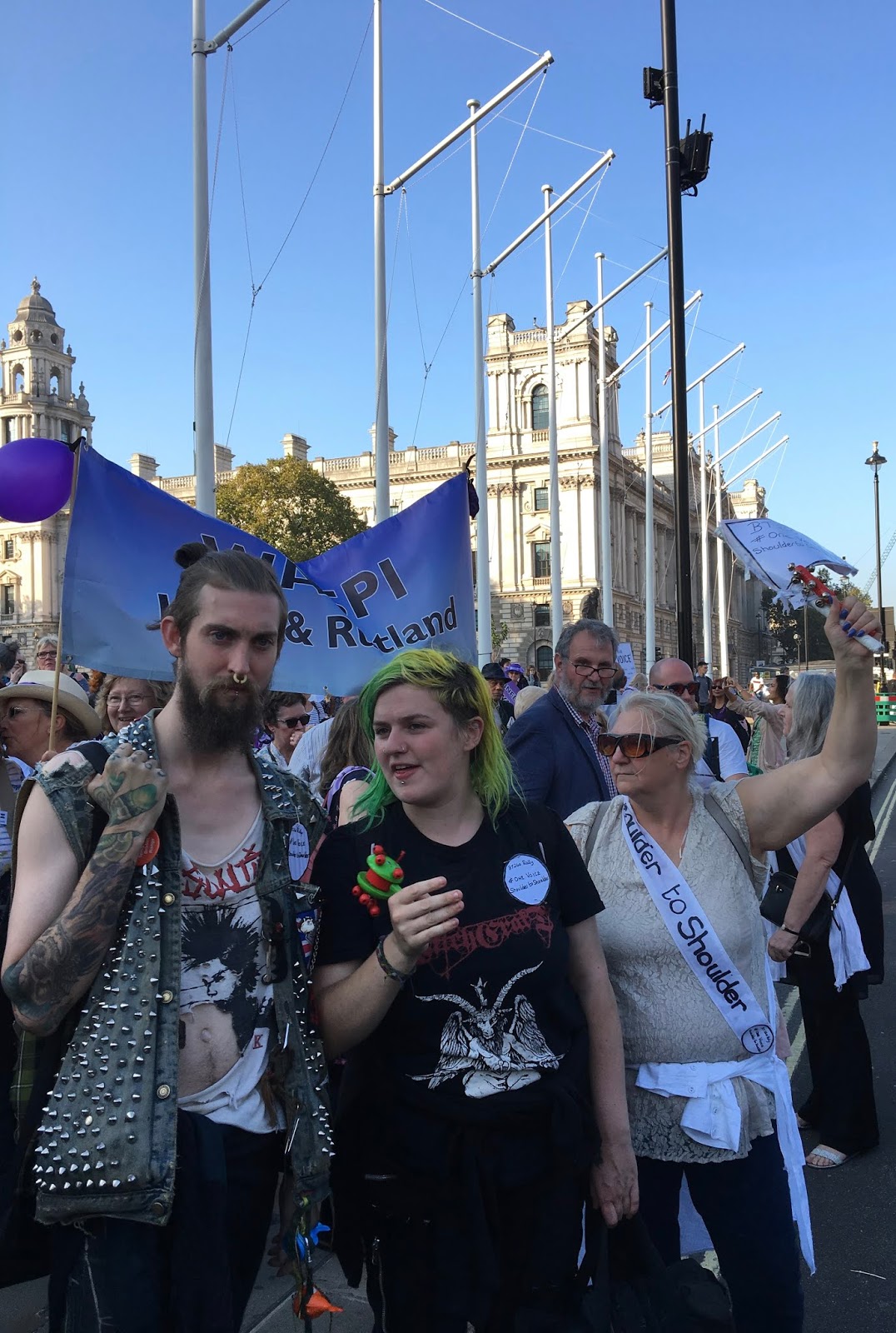
But thinking about the Suffragettes exactly, was what I was doing doing earlier this week, outside Parliament, in the course of another occupation: a blockade of the road outside the House of Commons, causing chaos, hopefully, as far back as Downing Street where, possibly  PM Theresa May was sitting in her limo, unable to leave, while her less fortunate sixty/fifty something sisters were stopping traffic, and bringing Westminster to a standstill. 

You might have heard about the 'Waspi' campaign: Women Against State Pension Inequality, and recognised the purple branding, borrowed from the Suffragettes, of an issue now rapidly gaining attention from all but those who don't want to hear, at Westminster, and elsewhere.

At a time when austerity, despite Mrs May's claims of abolition, has reduced so many to an unprecedented level of poverty, that women are expected to cope without six years of pension for which they had already paid, throughout their lives, in work, and in times of childcare, is nothing less than a national scandal. 

And the resistance to this injustice, rapidly increasing as more and more women discover that the financial security they had believed was theirs by right has been quietly removed, is now part of a wider campaign, including other lobbying groups, notably BackTo60, led by Yvette Greenway and Joanne Welch (seen above), as well as We Paid In You Pay Out.

Backto60, backed by human rights barrister Michael Mansfield, and lawyers Birnberg Pierce, has now secured a hearing in the High Court in regard to its application for a Judicial Review, based on an argument addressing the unfair and hasty implementation of an imposed rise in age qualification for women, failing to inform those affected, and leaving them with little time or ability to prepare for the loss of as much as six years of pension support. 

On Wednesday this week, there was a rally and day of protest organised under the 'One Voice' movement - a body which unifies all groups campaigning to put right the injustice of so many women robbed of so many years of National Insurance contributions.

This event began at an appropriate place: the Reformers' Tree in Hyde Park, a point of memorial commemorating an oak tree used as a meeting place for members of the Reform League, in 1866, when demanding the right to vote for all adult men. The tree was burnt to a stump in the course of one protest, but its location became a symbol of the right of the people to assemble - a tradition maintained to this day, and marked in 2000 by a mosaic, unveiled by Tony Benn.


In 1866, demanding the vote for all men was seen as a desperately radical and dangerous proposition, but the question of universal suffrage, and the inclusion of women, was unthinkable. 

Here we are, only a hundred years after the right to vote was given to some women, and still we struggle to secure our rights to equality. But although in the cartoon above the only woman is looking on from a safe distance, it is her great granddaughters now taking the axe to the rotten trunk of an establishment still dominated by male power, and an institutionalised indifference to the rights of women.

Some people - mostly men - would argue that the increase to 66 for the pension age is in itself a mark of equality, in that it applies the same level of qualification in age to both sexes. But this is to ignore the gross economic inequality that women of that generation have had to endure in their working lives, and also in their traditional roles as caregivers, not just in terms of childcare, but with family responsibilities to ageing parents, unpaid duties often taking them out of employment, and leaving them unable to make full NI contributions, or pay into any private pension fund.


Women reaching sixty on already low pay - and of course women are still paid less than men - exhausted after years of juggling work, and family responsibilities, perhaps unable to find work in a world in which older women are seen as virtually unemployable, are now in many cases facing the most extreme levels of hardship, with no hope of the pension they had paid for, and assumed would be there. In many cases, they received no notification of the change in age entitlement, and those that did had little option for saving enough money to help mitigate the loss of entitlement.

Some women have been left dependent on their husbands for financial support - but many women of that generation who have become divorced have had unfair settlements that ignored or minimised the loss of future pension income. 

As one woman at the protest on Wednesday explained to me, showing the scars from an operation to reconstruct her broken arm after an assault by her former husband - a frail, prematurely aged woman, who often goes without food, or relies on the generosity of a neighbour for a shared meal - she fears for those women of her age or younger still caught in an abusive relationship, because they do not have the economic independence of a pension, that would at least enable them to escape. 

Another serious consequence for women thrown into financial difficulties at this stage in their lives is in terms of their physical and mental health. Not only has improvement in life expectancy for women dropped by an appalling level of 91% since 2011, there is evidence of an unacknowledged impact on older women facing poverty as a result of pension loss, as Yvette Greenway explained to the assembled crowd in Hyde Park, with deeply troubling findings of a survey on depression and suicide amongst this group.

At the Reformers' tree, several other speakers addressed the gathered assembly of women. 

Sophie Walker gave the campaign the backing of the Women's Equality Party:


Sophie Walker

Investigative journalist and former Guardian Westminster correspondent David Hencke also spoke - he has written extensively about the campaign, for example here - and uncovered the previously unknown audit trail of treasury led appropriation of funds meant to cover the stolen years of pension: he also recorded a contribution to an item on that day's 'World at One' on BBC4 on this topic.


David Hencke

Off to Westminster next, where an even larger crowd of women was waiting, gathered around the statue of suffragist Millicent Fawcett - the first statue of a woman in Parliament Square - only placed there this year. In her arms she holds a banner proclaiming: 'Courage calls to courage everywhere'. 

Around Fawcett's statue now were members of a generation of women who perhaps have not been particularly politically active, until now: quite a few of them probably quite conservative by nature, and perhaps formerly Conservative voters. 

Not any more.

The crowd moved over towards a place directly opposite the House of Commons, now shrouded in scaffolding and protective wrapping as the hugely expensive renovation programme continues. No amount of protective wrapping, however, could possibly insulate those inside from the racket the women were making: with trumpets, drums, bongos, whistles, and a fair amount of less than respectful comments chanted in their direction:

Hey, hey, Theresa May: How Many Women Have You Robbed Today?

We Paid In, You Pay Out.

We're Pissed Off! We're Pissed Off! We're Pissed Off!

They were.

Some resorted to making a cacophony in the form of a more domestic method of protest: banging saucepans with kitchen cutlery, cacerolazo style. It seemed appropriate.

At one point, one of the men who had attended the protest, dressed as a Town Crier, read out a list of women who had died before receiving their post 60 pensions. He struggled to maintain his composure, and who could blame him, as he bravely read out the name of his own wife.

Others brought family members and supporters: 


Some bought dogs (his third demo, said this one's owner, proudly) :


Some attended in wheelchairs. Some carried pictures of those who could not afford the journey to London to attend - or who had also died before reaching their pension age.

Some MPs had already agreed to speak to the crowd: it was almost impossible to hear what they were saying, but it was significant that they were now keen to be associated with what is only now being recognised as an issue worth talking about. 


SNP members arrive at the demo.

All parties have been slow to recognise the importance of this issue - Labour has so far failed to grasp the electoral significance of providing the huge number of women affected by pension loss with a pledge to provide the full transitional support that they so desperately need. 

Curiously, however, I found myself standing next to someone who ... surely not? Someone who bore a distinct resemblance to the wife of the Labour leader. 

We can only hope, if it was her, that she went home and gave Jeremy a good talking to, over dinner. Come on, Jezza: you know what we need - and it could make all difference in constituencies like those held by the three marginal Tories here in Barnet, where there are thousands of women hit by this injustice. 

Earlier this year we made a documentary film, shot outside the Town Hall, on this very subject, and included views from a couple of local councillors, including former Tory Sury Khatri - deselected for daring to criticise the Capita contracts - who was also present on Wednesday.


Gratifying to note one right wing Labour MP who came over to take a look at the protest change his expression from one of mildly patronising amusement to one of distinct unease, surrounded by a surging crowd of women in such foul mood, and in no way inclined to move out of his way as they suddenly headed across the pavement, and on to the road outside Parliament.

Within seconds, the traffic ground to a halt. More and more women moved onto the road. After a while, the police response arrived. This consisted of one middle aged officer who politely asked, with genial wink, if we would move back to the pavement. We thought not. 

The women stayed in place, and eventually sat down in the road, obstinately refusing to budge, even when the only four spare policemen left in the Greater London area, after Tory budget cuts, were found and summoned to help. Protests at Parliament are common occurences, of course: sitting down in the road and stopping traffic for more than an house most certainly is not.


One of them, who looked young enough to be the grandson of most of the women there, appeared at something of a loss in terms of what to do, and instead wasted a lot of time talking importantly into his phone, probably asking for a transfer. Two of the older officers tried persuading the women sitting down to shift, telling them we were all creating a Public Nuisance, which was gratifying. 

The women sitting down stared back at the policemen and ignored them, knowing full well five officers could hardly arrest more than a thousand women outside Parliament. Where would they take the ringleaders, now that Holloway is closed?

The whole day was an inspiring moment, in fact, for anyone whose passion for political activism might be in danger of flagging. Empowerment is an overused term, but seeing women seizing the moment, and making their voices count in this way, using direct action, and political protest, to seize control, even temporarily, was something our suffragette mothers would have understood, and approved. If the political establishment refuses to engage in debate, and take action, how else can citizens force them to listen but in this way?

Courage calls to courage: now let's hope our parliamentary representatives are wise enough to listen, and brave enough to act to right this wrong. Whether through the High Court, or by  persistent lobbying, and organised protests like this, sooner or later, change must and will come.