Thursday, 13 June 2019

There's a rat in the library, what am I gonna do? Barnet Tories forced to agree a wider review of their savage cuts in service


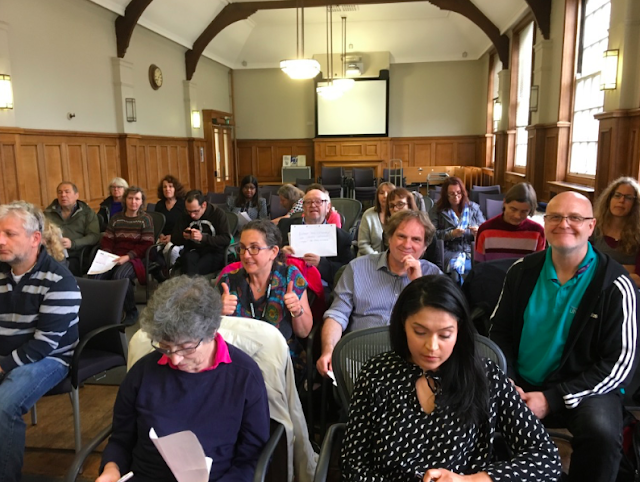
There was a meeting, on Tuesday night, at Hendon Town Hall, of the committee that now deals with what is left of Barnet's library service. 

I can't remember the name, without looking it up: hang on. 

Ah. 'Community Leadership and Libraries'. 

In other words, two things Barnet Tories don't care about, shoved together, in the hope no one will bother to turn up and ask questions. 

(Residents at the meeting might have thought that some Labour members don't care much about it either, as two of them didn't turn up, and nor did the two substitutes - with no explanation. This must not be repeated at any other meeting where issues of such importance to residents are being discussed).

Thankfully the two that did attend, that is to say Sara Conway and Reema Patel, more than made up for any absences by their skilful handling of the engagement with the many library campaigners present to demand a full review of (what is left of) the library service, post cuts - and then Sara Conway (who is the Labour PPC for Finchley and Golders Green) engineered the adoption of a motion that widened the proposed scope of said review.


'Kids need independence ... and books' says Labour's Sara Conway. Unison's John Burgess back right looking on

That this was agreed by Tories as well was due to several reasons: the reasonable, and impassioned arguments to do so from library supporters and Labour members; the need for Barnet to demonstrate to DCMS that the review idea cooked up by both of them in response to a complaint to the Minister about the nearly annihilated service was going to be apparently above board; and because most of the Tory members present didn't have a clue what was going on. 

On the Tory end of the committee table was stalwart councillor and Nelson Mandela tribute act Brian Gordon, who quite likes libraries - or at least his children do, and he is on record as saying they spend hours studying in their local one, or rather they did, but these days, of course, anyone under 15 isn't allowed in the unstaffed library without an adult. 

Gordon, tutting at the sight of People's Mayor Mr Shepherd ostentatiously reading the Morning Star in the front row, instead of listening to his words of wisdom, (in fact Mr Shepherd listens to everything from behind his paper, and makes perfectly timed and pithy observations of varying degrees of impertinence on the issues under discussion) took issue with veteran library campaigner Keith Martin, (pictured above) for daring to suggest that the loss of a library committee, and the gradual downgrading of the service to a mere adjunct to another committee represented the contempt Barnet Tories had for the idea of public libraries. 

Cllr Gordon thought Keith was being 'a bit trivial'. In truth, this is exactly representative of the Barnet Tory attitude: they cannot understand the value residents place on their library service - they are unthinking materialists, who see no point in anything that is not a commercial enterprise, and cannot, or will not, understand the importance of libraries, reading, literacy, and social interaction to the community they were elected to represent. 


Communities, as the committee title implies, are to be led, not engaged with, and people moaning about library cuts and the impact on their community must keep quiet and listen to the wishes of their Tory masters, who know what is best for them. 

The rest of the new Tory members sat looking on, without comment, throughout the entire meeting: clearly at a loss to know what all the fuss was about. 

One of them, Roberto Weedon Sanz, who thinks he looks like Justin Trudeau (you don't), and was almost President of the Oxford Union, reckons he is going to be the next GLA member, in place of Andrew Dismore. (You won't).

The Barnet Tory approach to this election consists of choosing a fresh faced young man, or Dan Thomas, who can carry off the blazer and pocket handkerchief look, keep his mouth shut, and look the part. Well, it didn't work with Dan Thomas, and it won't work with Roberto. 

Dan Thomas, of course, having been rejected by voters (twice) in Neil Kinnock's old constituency, and then at the GLA, has managed to stand (unopposed) for the Leadership of Barnet Tory group - and at last (unopposed) he won an election. Congratulations. To those who had the sense not to stand. Commiserations to Dan Thomas.

He had no competition for the role because no Barnet Tory with any sense wants the poisoned chalice this represents, in the midst of the wreckage of the Capita contracts.  

Thomas, of course, is the last standing defender of those contracts, because he was such an enthusiastic supporter of them, and now cannot backtrack without admitting he was wrong, despite the majority of his colleagues now privately admitting this - and the newer intake of members being appalled by the mess they have inherited from former Tory administrations.

Last year, after the Capita fraud was exposed, as well as the catastrophic absence of adequate financial controls; as services continued to decline, and contractual fees increase, for one brief shining moment it seemed as if many services, if not all, would be brought back in house. 

Not now. Despite everything, including further revelations such as the almighty cock up of the administration of Barnet's Pension scheme (including my benefits, in regard to which I've submitted a complaint to the Pensions Ombudsman) - guess what? We learn that our Tory chums now intend to Carry On Regardless. Even Highways are now not going to be returned, despite the plague of potholes and broken pavements all over Broken Barnet. 

The gross stupidity of this is beyond belief: or it would be, anywhere else.

Back to the meeting. 


Reuben Thompstone, as Chair of any meeting, favours the approach of speaking like an automaton, as if he were alone in the universe, with no one listening, passing out instruction to a thankless, Godless world in his inimitable, brutally clipped, antipodean tones. 

Time 'allowed' for residents to take part in any council meeting is of course strictly limited, as they don't want to encourage That Sort of Thing, and the council's constitution is constantly being tinkered with in order to make it more and more difficult for residents to hold members to account: time limits, limits on issues which may be discussed, limits on the meetings which may be questioned. Other tactics are deployed to prevent effective challenge from residents, including meetings held with almost no publicity, questions batted off with evasive responses, or promises of written responses which cannot be challenged, FOI questions constantly obstructed or delayed for no good reason, or redacted to the point of absurdity - etc etc.

At this meeting there had been lots of questions submitted, and several people had asked to speak. This is normally done before any supplementary questions. Keith Martin and Barbara Jacobson and others spoke - (largely unheard as the Chair kept his mike on and theirs was not working). 


A little girl called Sia also spoke, very quietly, but determinedly, about the impact the library cuts had on her. Her mother is a nurse, and works long hours. Sia can no longer visit the library after school, or when there are any staff there to help her. She is one of thousands of children in this borough similarly affected: this is clearly going to have a direct impact on their lives and educational achievement.

The Chair then wasted much of the remaining time by insisting on reading out endless lists of people who had put in questions but were not there to ask follow ups. Emily Burnham, who coordinates the Save Barnet Libraries campaign, continually explained there was no need to do this as they knew who was going to speak: he ignored her and carried on, using up the time. This meant that Mary Beer, who had been going to speak, was told she could not do so. She had already provided committee members with documents that related to her brilliant exposure of the fictional 'savings' that had supposedly been the purpose of the cuts. But she was silenced. 

She sat at the table anyway, and despite all the commands from Thompstone to be quiet and sit down, read her speech, drowning out his bleated orders, until he shut up.

He had interrupted a distressing statement read by Jennifer, written by a disabled user of a library who has MS, and was unable to attend the meeting in person - in fact, as she explained, she can no longer visit her local library, unstaffed, with no toilet access*, and no one to help her: the Chair suddenly interrupted and asked why this needed to be read it out. It was grossly insensitive, and represented the attitude of Barnet Tories to all those affected by the cuts in service, in staffed hours and in the reduction of space: disabled residents, disadvantaged residents: the elderly, and children. Members of the public protested that they wanted to hear the statement, and he gave up.

* One mother, when access to the same library toilet was refused, was forced to take her child to urinate in the library car park.


People's Mayor Mr Shepherd

Labour's library lead Sara Conway raised concerns about the disproportionate impact on these groups - as well as worries about safeguarding, after the recent incident posted on social media of a man openly watching porn on a PC at an unstaffed Church End library, filmed by a passer by, and the revelation that nothing had been done since the cuts to ensure the necessary filters were in place. This is not an isolated incident, but action was only taken after this example was reported - and a reporter from the Standard asked questions. Oh, and Sara mentioned that her local library in Burnt Oak was not cleaned for a period of a month, and that a dead rat had been found in one of the shelves ... 

After all the comments by members of the public, and the issues raised by Labour members, Cllr Conway proposed her motion to toughen up what would otherwise be a nominal review into the current library service. And for once an opposition was not automatically rejected. This is a big step forward: but now we have to see that this review is independent, fair, and inclusive - not another Barnet nonsultation, not merely lip service to the obligation to hold a review, but an exercise that answers truthfully the question of impact of the devastating cuts. 

After the meeting, Mary Beer stood on the stairs of the Town Hall and again read out the points she was prevented from making in the meeting. The text is here: easy to see why they didn't want her to read it out in the committee room:


Mary Beer


You responded to my question by claiming:


"The library service budget has reduced by £1.61m p.a. Commercial spaces are currently let within East Finchley, Edgware, Golders Green, and Hendon libraries. Current rentals total £188,000 p.a with a further circa £60,000 under lease negotiation."

But let’s look at your first example, East Finchley for a minute:

Here is the sign from 2017 when you removed the ground floor study space claiming it would be converted to ’lettable space'

Here’s what it looked like before, and it was well-used.


Here’s the contract in which you agreed to pay a contractor, SW Bruce, the sum of £271,961 on 4th April, 2017 to remove this space.  


This space has remained empty and inaccessible since 2017. 

Your claim, therefore, that across four libraries a total of £188,000 has been earned in revenue cannot offset even one library’s ‘reconfiguration’, even if you include ‘under negotiations'.  

Surely, the truth of the matter is that this expensive removal of study space and diminishment of much needed public service has yielded absolutely no profit whatsoever.

Indeed, if you look at the removal of space in Edgware library’s reconfiguration, which cost £311,688 paid to Mulalley and Company Ltd on 11th May, 2017 and the cost of removing space from Chipping Barnet the sum of which was £462,541 paid to Carmelcrest Ltd on 1st June, 2016, you have spent £1,046,190 on removing public space for just 3 libraries.  

How can you claim that a total of £188k per year in the last two years has offset over one million pounds in the cost of removing this space?  

How can you truthfully claim the removal of East Finchley’s ground floor study space to turn it into ‘lettable space’, when the space has sat empty for two years, represents any kind of cost savings?  


When you consider the 2017/2018 procurement contract, it shows the costs of diminishing Barnet’s library service to be about £14m (per your own document)?  

Yet this doesn’t include the failure to realise any additional rental income to offset the space removed from public use nor the additional costs of security guards to keep people out of the library.  

Therefore, surely your claims of ‘savings’ are disingenuous at best? 


In fact Mary has highlighted here the essential deception not only of the library cuts, but of the greater part of the 'Easynomics' financial strategy of Barnet Tory policy - an assault on public services in the name of 'savings', that ends in not in net gain, but loss: this is what has happened with the Capita contracts, and in almost every venture they set in motion. 

All we can do now is to continue to assert our right to scrutinise what they do, and hold them to account. 

Even if they refuse to listen now, sooner, rather than later, they are going to face the consequences of their own folly.


Thursday, 9 May 2019

Joint Post - No Assurance from Capita


Tory Leader Richard Cornelius, rumoured this week to be stepping down, signed the two massive contracts with Capita on the basis that it would provide 'better services, for less money'. It hasn't. As fellow blogger John Dix, 'Mr Reasonable', reported here last week after a catastrophic Audit meeting: "we have paid Capita £145.9 million more than the contracted sum ...". 

While fees continue to increase, and local services in Barnet continue to fail, it has become apparent that lessons have not been learned from the £2 million fraud recently perpetrated by a Capita manager, unnoticed by Barnet or Capita, which exposed an abysmal lack of any competent system of financial controls in regard to the processes and performance of the contractual partnership. 

At this meeting, as the external auditors raised, as they have done for two years, their serious concerns about this issue it emerged that Capita see no reason to provide any audit assurance of the services they provide to Barnet - even though this is a contractual obligation.

If it is true that the Tory leader who has promoted and retained the contractual partnership with Capita is now leaving, it is essential that the newer, and more sensible Tory members,  who have been faced with the mess created by their longer serving colleagues, elect a replacement who will have the courage and integrity to end these contracts, and restore direct control of local services to the council itself. 

In the meanwhile, here is a joint statement from all four Barnet bloggers, to raise our concerns about the very real and continuing risks posed by this failing partnership:

Capita - “Not Minded”

 At the Barnet Council Audit Committee on 1 May the external auditor from BDO made some very worrying and serious statements about the controls systems in place. This follows a £2 million fraud last year, and pervasive problems with the pensions and payroll administration.

 “You don’t have a particularly strong control environment”, the auditor reported, and then stated that Capita were “not minded” to provide assurance over systems running processes on Barnet Council’s behalf.

 This is an astonishing response from Capita.

 Responsibility for assurance of these systems, run from Capita’s offices around the United Kingdom, falls to Barnet Council’s Internal Audit Team.

 As the External Auditor made clear, the Internal Audit team is doing good work “but it doesn’t give you that level of assurance that you would expect with so much of the service outsourced”.

 Given that Capita provide so many of Barnet’s back office systems this is a very serious situation, especially as the external auditor raised this problem two years ago, before the £2 million fraud was discovered.

 As bloggers who have closely followed and reported the story of Barnet’s partnership with Capita, we are deeply concerned about this situation and alarmed that neither the auditor nor committee members were aware that assurance of Capita’s systems is a contractual requirement, and not something that could be provided at their discretion.

 We ask the following questions of the Council:

Why were audit committee members not made aware of the auditor's concerns when they were raised two years ago?

Why are Capita "not minded" to provide assurance over their systems when the contract appears to indicate that they must provide that assurance?

Why did Grant Thornton not pick this matter up when they were the Council's External Auditors or as part of their contract review following the fraud?

Why have the Council's contract monitoring officers not identified this problem before now?

If BDO are saying the Council does not have a strong control environment, what are the risks of another fraud or systems failure happening?

And finally, 

How can Capita continue to retain the confidence of the Council without such assurances?


We ask that the Council arranges for a forensic review/audit of both Capita contracts to address the contractual failures raised by the External Auditor as a matter of the utmost urgency, to be paid for by Capita, before any further decisions are made on what services Capita will continue to provide. 

Failure to do so can only have the most serious consequences for the financial security of this borough, and the well being of all residents.


Signed:


Derek Dishman

John Dix

Theresa Musgrove

Roger Tichborne


Monday, 15 April 2019

Suffer the little Children: the unwritten history of the former St Vincent's School and Orphanage, Mill Hill


"Whatever you did not do for the least of these, you did not do for me". 

(Matthew 25, verse 40): said to be the inspiration for St Vincent de Paul, when founding the Order of the Daughters of  Charity 


Updated, 18th January 2024

I am updating this post, which still attracts so many visitors, with the welcome news that two nuns and a former 'carer' employed by the Order of the Daughters of Charity of St Vincent de Paul at Smyllum Orphanage, in Scotland, who were found guilty last December of abusing vulnerable children in their care, have now been sent to prison.

Sister Sarah McDermott, 79, Sister Eileen Igoe, 79, and carer Margaret Hughes, 76, mistreated children at Smyllum Park in Lanark from 1969 until 1981, and have each been given three year sentences. 

According to this BBC report the judge commented:

"As I said to you when you were found guilty, you failed in your duty of care to the children in Smyllum and fell far short of your moral calling and commitment."

The judge said the "lasting harm" and "the serious nature" of the offences meant only custodial sentences were appropriate.

He added that the sentences were shorter than they otherwise would have been on account of the women's ages and health."

Among the offences described in court were an incident in which a child was forced to eat their own vomit, another in which a nun humiliated a child who had soiled their bedsheets, physical abuse, and beating a child who reported witnessing the sexual of abuse of her brother in a toilet cubicle. 

I wish I could say I was surprised by the nature of these offences, but that would not be true. I hope that anyone who suffered similar abuse at any institution run by the Order will seek counselling - and if necessary, legal advice.


__________________________________________________________________

Of all the posts that have been published on this blog, the one that continues to receive the most re-readings, and certainly the most comments, is the piece I wrote, in a blaze of fury, some while ago, about the Catholic primary school I attended in Mill Hill, that was run by the Daughters of Charity of St Vincent de Paul. 

https://wwwbrokenbarnet.blogspot.com/2013/01/growing-up-in-broken-barnet-making-of.html

To be clear - the school I attended has now been replaced by a more modern one, across the road from the original site, and is well thought of by local Catholic families.

The scripture quoted above is said to have been at the heart of St Vincent de Paul's mission, when he founded the Order: evidently a man of great compassion, and tenderness, towards the foundlings and poor children he felt driven to help. It would be wrong to overlook the good work that his charitable mission has undertaken, all over the world. Sadly, however, there appears, in much of the twentieth century, at least, to have been in some part a failure in the vision and values of those trusted with the continuation of his legacy.

That the impact of something that happened in childhood can follow you into adult life is of no surprise to those who also attended St Vincent's, or the orphanage that stood behind the school. Some of us have memories that have never faded, and seem as intense now as they were then. Fellow local blogger Roger Tichborne was also a pupil here: it is no coincidence, I think, that an early experience of injustice leads in later life to a deep need to take back control, and compensate for the abuse you suffered in silence, as a child.

I don't publish all of the comments I receive, usually because some of them relate to individuals who may still be alive. The ones that I do publish are difficult to read, but I think need to be placed on record.

The need for acknowledgement of this sort of abuse, and the harm that it did, is now something recognised by government, to a limited degree. There is now an investigation into child sexual abuse, in the form of the IICSA inquiry, which covers England and Wales : the Inquiry Into Child Sexual Abuse - its purpose largely being as follows:

To consider the extent to which State and non-State institutions have failed in their duty of care to protect children from sexual abuse and exploitation; to consider the extent to which those failings have since been addressed; to identify further action needed to address any failings identified; to consider the steps which it is necessary for State and non-State institutions to take in order to protect children from such abuse in future; and to publish a report with recommendations.

In Scotland there is a similar process, The Scottish Child Abuse Inquiry, or SCAI - with a wider remit, which includes all forms of abuse while in care, in childhood: sexual, psychological - and emotional. This is their definition of abuse:

"Abuse" for the purpose of this Inquiry is to be taken to mean primarily physical abuse and sexual abuse, with associated psychological and emotional abuse. The Inquiry will be entitled to consider other forms of abuse at its discretion, including medical experimentation, spiritual abuse, unacceptable practices (such as deprivation of contact with siblings) and neglect, but these matters do not require to be examined individually or in isolation.

So: the Scottish inquiry is looking at abuse of children in care: and IICSA is investigating only sexual abuse, but not only in care, and includes educational establishments. 

This means there is no investigation of non sexual abuse of children in English schools or care institutions, as there would be in Scotland. This seems wrong.


The Scottish Inquiry is of interest to me on two counts: in that it has a broader definition of abuse - and that it has directly addressed allegations of all three types in regard to one of the institutions run by the order of nuns who were responsible for St Vincent's School and Orphanage in Mill Hill, that is to say the Daughters of Charity.


Recently someone left a comment on my post -unpublished - in regard to an individual they claimed had worked at one of the Mill Hill institutions, as well as one in Scotland. I wasn't sure about this at first, as one of the details seemed inaccurate: until I checked and found an obscure piece of information that proved the reference was correct, suggested the comment was authentic - and should be investigated. The commenter said that they had tried to involve the police, who had not taken the allegations seriously. I wonder if they took the trouble to check the Scottish Inquiry's published findings?

Because I then looked at the Scottish inquiry's website, and noted that there had already been a judgement, published on October 11th, 2018, in relation to the Daughters of Charity. It was late at night, when I noticed this: I thought I would have a quick look. 

Hours later, I was unable to sleep, after what I had read. Link here. To clarify: this is a formal finding of abuse by the Inquiry, chaired by Lady Smith, based on a case study of only two of the homes run by the order in Scotland, ie Smyllum, and Bellevue. 


I find that children were abused in both
Bellevue and Smyllum, the two institutions
that were the main focus of the case study.
The abuse which took place was physical,
emotional and sexual. In particular, children
were beaten, they were humiliated, they were
punished for bed-wetting, they were forcefed, 
they were subjected to abusive washing
and bathing routines, some were sexually
abused and they were subjected to a range
of treatments amounting to emotional abuse. 


Details are given of the types of abuse perpetrated on children in the 'care' of the order:


• For many children who were in Smyllum
and Bellevue, the homes were places of
fear, coercive control, threat, excessive
discipline and emotional, physical and
sexual abuse, where they found no love,
no compassion, no dignity and no comfort.

• Children were physically abused. They
were hit with and without implements,
either in an excess of punishment or for
reasons which the child could not fathom.
The implements used included leather
straps, the “Lochgelly Tawse,” hairbrushes,
sticks, footwear, rosary beads, wooden
crucifixes and a dog’s lead.

• For some children, being hit was a normal
aspect of daily life.

• The physical punishments meted out
to children went beyond what was
acceptable at the time whether as

punishment in schools or in the home. 

No mercy was given to children who - unsurprisingly - wet themselves at night:

• Children who were bed-wetters were
abused physically and emotionally.
They were beaten, put in cold baths and
humiliated in ways that included “wearing”
their wet sheets and being subjected to
hurtful name-calling by Sisters and by
other children who were encouraged by
Sisters to do so.

My own experience of St Vincent's Primary School, with Maureen O'Donovan, the teacher I had at the age of six, when I transferred there, was not dissimilar: the same cruelty and humiliation. It was a sharp contrast to the nearly two years I had spent at an ordinary state primary school, where the teacher was kind, funny, and gentle.  My mother took me out of there, however,  because she thought I would be brainwashed by Anglican heresy. Brainwashing of children in the Catholic tradition was perfectly fine, of course: and much more effective.

St Vincent's came as an almighty shock: but if it was that bad - for many of us, at least, in the school - what on earth was it like in the Orphanage? 

The headmistress of the school, an elderly, short tempered Irish nun, ran the school on the basis of harsh discipline, and fear. Although I know of no cases of sexual abuse in the school, one of my classmates reported the experience of being forced to undress, alone, in front of this headmistress, in her office, supposedly before a medical examination, a routine practice, and one she clearly enjoyed. I was terrified of the same thing happened to me, for all the time I was at that school. Was her behaviour abusive? I think so. We didn't know what sexual abuse was, at that age - we only knew this 'interest' of hers was something peculiar, and frightening: meant to humiliate.

Beating was a part of the culture of fear at the school: Sister had what was known as 'the bat', which was reserved for boys who stepped out of line in some way: on one occasion I remember one boy being threatened with it being used in front of the class. The threat was effective: the fear of it was usually enough in itself.

In O'Donovan's class of six year olds, beating was common too: boys and girls - the favoured implement a heavy wooden ruler, with a usefully sharp metal edge. The friend who reported the headmistress's  prurient interest in undressed children once had the palm of her hand cut open by the ruler. More usually you had to have it on your knuckles, as I recall, the hand held tightly in a fist, so it would expose the bone, and hurt more. 

When it was my turn, it was usually for spelling mistakes, or not remembering times tables, or part of the catechism. Untidy writing was also a crime worthy of assault: being dyspraxic and naturally left handed, and being forced to write right handed in O'Donovan's approved italic style didn't help: deviance from the norm was not allowed, and had to be punished. I write laboriously in fountain pen, now, with a special nib, so that my normally illegible handwriting (illegible even to me) is readable.

We were absolutely not allowed to visit the toilets other than at break time. Inevitably children would wet themselves: pools of urine on the parquet floor & wet seats were not even anything unusual. If you were caught, though, you would have to clean it up, and be exposed in front of the whole class. 

Children who cried after such treatment were mocked, and jeered at as 'cry babies' by O'Donovan: one girl, called Alison, was perpetually in tears, and labelled in this way - her parents removed her from the class. Most of us did not dare cry in class - rather than do this I used to dig my nails into the palms of my hands, when on the verge of tears, good old Catholic mortification of the flesh, not as a penance, but a distraction. It usually worked, but I still fear crying in front of anyone. 

The worst cruelty and punishment was reserved for the children who could least resist: those who were not so intellectually able, dumped on the 'baby' or 'lazy' table: often made to stand on their chairs for ages, hands on head: as I said in the older post, this sort of torture was pretty much up to CIA standards of torture: bound to break the spirit of any dissenting child, which is what was intended.

Most parents would anyway not have dared criticise such discipline : the Catholic Church, its schools and teachers, at that time, were above criticism. We did not dare tell our parents that we had been 'in trouble', anyway. My own mother would probably have thought it only what we deserved.


As one commenter remarked on the previous post, however: we were lucky in one sense. We went home at night, and escaped. Those who were at the Orphanage had nowhere to go. And what happened there, only they know. And the Order would know: because at least in one case, according to another commenter, a legal claim in regard to his treatment was allegedly settled out of court. What form the reported abuse took, is unclear: but it strongly suggests to me that a similar inquiry to the one that has looked at, and continues to look at, the Scottish homes run by the Daughters of Charity, necessarily should be created to investigate all their homes and schools in England and Wales.

The Scottish Inquiry did look briefly at St Vincent's in Newcastle, to which place a Smyllum family had been transferred: the finding tells us that in 1995, a priest had admitted sexually abusing boys at this English home - he pleaded guilty to six charges of indecent assault. We also learn that although his behaviour had been known about since 1994, he was not laicised for another eighteen years. 

At the beginning of this month, the Inquiry announced further investigations into other Scottish care homes run by the Order: and a good thing too.

After contacting IICSA to see if they will be investigating the Order as part of their remit, I had the following response:


As you may be aware, the Inquiry does have an investigation into the Roman Catholic Church in England and Wales. As part of that investigation the Panel selected two institutions as case studies. The first is the English Benedictine Congregation and the second is the Archdiocese of Birmingham. The Inquiry has held three public hearings to date in relation to those two case studies. In October this year the Inquiry will hold a further public hearing that will consider matters relating to the wider Roman Catholic Church in England and Wales. No decisions have been taken as to what matters or institutions the Panel will hear evidence about, including whether it will consider matters relating to the Daughters of Charity, for example. The Inquiry will publish any update on its website in due course.

I suggest therefore that anyone who reads this who wishes to report any allegation of sexual abuse in any institution in England or Wales run by this Order does so, via the Inquiry's website: link here - or to the police.

The terms of reference also state that IICSA will:

Liaise with ongoing inquiries, including those currently being conducted in Northern Ireland and Scotland, with a view to (a) ensuring that relevant information is shared, and (b) identifying any State or non-State institutions with child protection obligations that currently fall outside the scope of the present Inquiry and those being conducted in the devolved jurisdictions;

Anyone who suffered non sexual abuse, in England or Wales, of a psychological, emotional or spiritual nature: it seems that there is no one to tell, other than by seeking counselling - of the right sort. That can be very difficult to find, unfortunately.

One might hope that the Catholic church in England and Wales would voluntarily set in course their own investigations - but that seems to be unlikely. And in my view that is a gross misjudgement, as until this shameful episode in the Church's history is acknowledged, as well as the damage done to victims - and to the image of God and Christian love that it claims to represent - it will never recover its credibility as a religious organisation.


The UK headquarters of the Order of the Daughters of Charity is in Mill Hill: across the road from the old school and orphanage, which were sold to developers - even the old chapel is being advertised for would be conversion - and much of which now has now become another conglomeration of luxury housing - next door to the site of the demolished National Institute for Medical Research. 

The Scottish findings make the following observation:

The Order’s position

The Order has not admitted that children
were abused whilst in their care although
Sister Ellen Flynn, the Provincial of the
Order in the UK, did indicate that it was
now accepted that there was more than a
possibility that some abuse had occurred.

12
That represents some progress from the
position adopted in the 1990s as illustrated

by the evidence of an applicant, Sister “Louise,” 
who was in Bellevue and Smyllum
as a child and later became a Sister herself.
When she was at a conference in Mill Hill in
London, in the 1990s, a Sister from the Order
who recognised her tried to pressurise her
into saying that the allegations of past abuse
that were being made were not true.

13 Her response was to tell that Sister that the Order
needed to listen to what was being said,
explaining that she herself had also been
abused.

It was accepted on behalf of the Order
that many of the practices spoken about
by applicants, including responses to bedwetting, 
force-feeding, certain washing
practices and beatings would, if they
happened, constitute abuse. In relation to
the evidence given by applicants about
humiliation for bed-wetting, for example,
Sister Ellen Flynn, stated that, if children
were humiliated for wetting the bed, “... that
would be completely against our values
and we would consider it wrong and we
would consider it a form of abuse.”

14 She “absolutely” accepted that force-feeding
would be a form of abuse and that beatings
using implements would be abusive.

I have had some correspondence with the head of the Order myself, in the autumn of 2017, and she knew about my experience of the school; the 'discipline', the humiliation; the fear instilled in small children.

The way in which this correspondence came about was rather unusual, entirely by coincidence: I had been engaged in some historical research which connected in part to Mill Hill, and was taken aback to find one of the properties was owned by the Order which had run St Vincent's. I wrote to the Order's archivist to ask if they had any information, but had no reply, at first  - so wrote again, and the Provincial head responded. I also took the opportunity to mention that I was a former pupil, and had to admit to having had less than happy memories of my time in the school. 

I directed her to the post I had written, and pointed out that I had contacted the Diocese of Westminster to ask what sort of support or guidance they offered the people who were contacting me with reports of ill treatment or abuse either from the Mill Hill school or orphanage, or other local Catholic institutions. The reply had been useless: all they came up with - eventually, after much prompting - was a copy of a leaflet, and the assurance that all parishes now had a coordinator for sexual abuse issues. I replied to the Diocesan representative that those who had been abused while in the care of the Church would now hardly be likely to be practising Catholics, or parishioners. 

The head of the Order replied, and said:  "I assure you of my hopes and prayers for all those who have suffered any form of abuse and especially in connection with the Daughters of Charity ..." 

"In connection with" ... not 'by' ... 

She is in an invidious position, of course: made responsible for dealing with the damage done by previous generations of nuns and priests, and left as guardian of the reputation of an order, and representative of a Church, whose service, charitable and pastoral work is now overshadowed by allegations of abusive behaviour in the past. As Lady Smith commented, in relation to the homes in Scotland run by the Daughters of Charity:

The provision, by the Order, of homes for
the residential care of children in a way
which routinely and consistently met that
description would have been in keeping
with their mission and with Christ’s teaching.
Sadly, I have, in the light of the evidence,
concluded that that did not happen. 

The morning after reading this report I was by chance in Mill Hill, for an appointment, and decided to walk part of the way home, past St Joseph's, another Mill Hill Catholic building - and now another development - then past the house where my aunt, uncle and grandmother lived, off Lawrence Street, up to the Ridgeway, passing the former St Mary's Abbey, now - yes: more housing. Outwardly not much has changed, since my childhood: but it was a melancholy walk, all the same, family members no longer there, and the buildings that remain on the Ridgeway holding painful memories.

Mill Hill village was once a place of nonconformity, and religious dissent: home of a public school for boys with such a background; a settlement of Quakers - and the chosen location for several Catholic institutions. 

I walked along the Ridgeway, past the Provincial House, where the coach that used to take me home always parked: I remembered the sense of relief I associated with reaching the Lodge to the House, knowing I was safe at last, and going home.

Crossing the road, you pass along the old wall of the school, and all these years later, I still feel the sinking feeling I always had, in the pit of my stomach, as soon as the morning coach stopped here. 

Down the side track, which slopes down to the Orphanage, the first thing you see, after the former infants' playground, is the one school building they have not knocked down: Miss O'Donovan's class.


Of all the parts of the school to leave standing ... well: I suppose it is a memorial, of sorts. Let the proud new house owner listen very carefully, in the small hours, for the whispering of terrified small children, and the voice of Maureen O'Donovan, in her grating Kerry accent, relentlessly insulting the class: Empty vessels make the most sound ... 

Down the steep lane, facing the beauty of Totteridge Valley, is the old Orphanage:  as separate from the school as were its inmates, kept away from us, incommunicado, with one or two exceptions sent to the school for eleven plus, before the last few children were decanted into a new, smaller centre, on the other side of the road.

The orphanage now is still nothing more than a grim, late Victorian building so institutionalised in terms of architectural language, it is hard to see why anyone would want to buy a flat there now. 

And hard to imagine so many generations of vulnerable children living in isolation there, on the Ridgeway, looking onto what might as well have been a painted backdrop to the grudging misery of their cloistered lives; surrounded by natural beauty on one side, and the bleak indifference of the Orphanage on the other.

See also this post from 2020.

Postscript: The lost children

One of the accusations recently levelled against those responsible for the running of the Smyllum care home was in regard to what was feared to be the mass burial, with no record, of children who died there, over the many years it was in operation. 

Lady Smith's findings state the following:

Burial records show that between 1900 and
1981, there were 16 under 18-year olds who
were recorded as having been residents at
Smyllum buried in the “Smyllum Plot” within
the cemetery of St Mary’s Parish Church,
Lanark. There is no record of the individual
lairs and there are no headstones to mark
them. Various Sisters and Charlie Forsyth
are also buried in the St Mary’s Cemetery.
However, their graves are marked and have
headstones with inscriptions.

It is important not to over-sensationalise the issue: but this would seem to be a low number of deaths, if it is meant to represent the total number over an eighty year period: the findings here carefully note the records refer to a plot of land in the local parish church. Were others buried elsewhere?

I had asked the head of the Provincial Order where in the grounds of the Mill Hill site there was a burial ground for children who died there. She replied that there were no surviving records of any deaths or burials, and that she was sure any that died would have been buried in local Catholic graveyards, or by their families.

There were no local Catholic graveyards, in fact, for much of the earlier history of the Orphanage. And the children who were sent to Mill Hill, as records cross matched from census entries show, were from workhouses in the poorest parts of London, many therefore likely to be in ill health - and long separated from their families.

According to records held by the Wellcome Library, in 1898,  a report of the Medical Officer of Health for Hendon found the following:

At St. Vincent's Orphanage, Mill Hill, 12 deaths occurred, 

a high number when it is considered that the average number is 
about two hundred. The children at this institution are in the 
majority of cases feeble, debilitated, and tubercular when
admitted, and very often are taken from the London streets to
the Orphanage until their healths are improved, and after a stay
of a year or two, may-be, return. 

Return: or die, as we see from that year's record. Twelve children in one year alone lost their lives: where were they laid to rest?

It is easy to find a sample pair of infant children - they were all boys, in the early days - who died at the Orphanage, and who very probably were not buried in any Catholic church yard. Smyllum had a Catholic parish with a church yard: hard to think of any local equivalent in Mill Hill. 

Let these two at least have a name:

What about Ernest Wattam, who died aged two, from a throat infection, in 1912? The nun who was the informant at death knew nothing about his parentage, other than that he came from Hampstead.

Joseph Vincent Gibson, also aged two, who died in 1892, of congenital syphilis: described only as 'a deserted child'. 

Who buried them, and where?

Not all the beautiful and extensive grounds of St Vincent's have been given over to development: some of the grassed over areas have been left untouched. There is, for example, as there was at Smyllum, a carefully maintained graveyard for the sisters, which, as you can read on the Order's website, is the place of a special commemorative mass for them, once a year. 

There is no record, however, of the children of many generations who were passed into the hands of the Order, and never left. 

It is not impossible that any who died there were buried somewhere in the grounds, in unmarked graves, but if so, and the Order knows where that is, it might be seen as a gesture of reconciliation - and belated respect - to put some sort of memorial there, so they are not forgotten. 


Wednesday, 10 April 2019

A matter of life or death, or: A Critical Error, updated


Barnet Council: Open, Transparent, and Proactive

Just to update the previous post: 

After complaining about the remarks made by Councillor Anthony Finn, at the last Pensions meeting, the matter was investigated by Cllr Peter Zinkin, who is Chairman of the Tory group. He told me he thought Cllr Finn had apologised by email - but sent it to an old account. I suggested that he resend it to my current account: he agreed. 

Eventually, after two weeks, I received an apology. 


This describes the incident in rather benign terms, the reference to my not shooting myself apparently demonstrating a touching concern for my welfare - he merely wanted to know how Capita deals with such cases ... and to say that the word 'critical' is wrong when used in financial circumstances, and someone hasn't put a gun to their head.

Well, no: painfully insensitive metaphorical language set aside, 'critical error' is, in fact, an audit term.

Councillor Finn is Chair of Audit.

Oh dear. 

I did ask for a donation to be made to the Samaritans, in recognition of the real impact that 'critical errors' may have, when resulting in financial hardship: but this seems to have been overlooked. 

Ah well.

Moving on: Capita, of course, have not dealt with my case 'expeditiously', as I had made clear at the meeting, and ' how Capita deals with such cases' was explained by me, at some length, but Councillor Finn appears not to have heard. 

The arguments over the 'critical error' in my annual statements have been going on since last August, and despite admitting the cock up, Capita have ignored the letter from the Ombudsman, sent more than six weeks ago.

So: after a week of hearing nothing from the Director of Capita HR's Public Sector, who had promised to look at the case, I wrote to him, via his Linkedin account. He has now replied, saying he is looking into the matter.

Let's see.

And then: there was a Pensions Board meeting last night, to which I had submitted some questions.

They were sent last Thursday, but I was informed, after a day or so, that they had been barred, on the grounds that I missed the deadline. 

I missed the deadline by 4 hours, as there had been important data missing from the agenda reports, noted as 'To Follow', and I had thought, as had happened with the previous committee, that this rule had been suspended. 

I did not know the missing data had been published, in the last few minutes before the five day limit - the item itself still had 'Data Cleanse Summary (To Follow), see below ... and my questions were therefore written without sight of the updated statistics.


After appealing to the Chair, he was told, via governance, that he still could not allow these questions. 

You may think, as I do, especially after what happened at the last meeting, that this is unreasonable. 

Even more so since I have now discovered that over an hour after the questions barred from the meeting were sent by me, the governance officer, and yes, I have seen the email,  had actually contacted fellow blogger John Dix to see if he wanted to submit any questions ... he didn't, but the implication seems to be that his would have been accepted, whereas mine were out of time. 

I pointed this out too, to the officers and Chair, but - made no difference. 

I didn't bother going to the meeting. 

Here are the questions: all perfectly reasonable, you might think - but we still do not know if there are other scheme members affected by the same errors as in my case, or what compensation might be made available - if any ...

All addressed to the Data Quality Update.


1. According to the report, at Point 5.1 .1 Corporate Priorities and Performance:

"The Local Pension Board supports the delivery of the Council’s strategic objectives and priorities as expressed through the Corporate Plan, by assisting in maintaining the integrity of the pension Fund by monitoring the administration and compliance of the Fund".

Quite clearly Capita's administration of the Fund has consistently failed in terms of compliance, and in regard to the unacceptably high number of data errors. Does the Board not agree that the risks posed by continuing to leave the administration of the Fund with Capita represents a real risk to the integrity of the Fund, and if so, what measures can, or will, it take to ensure that the administration returns to the more efficient and safer hands of the council's own in house service?

2. The Data Error issue appears to interest (most of) the Conservative Pensions Committee Conservative members purely in terms of the triennial valuation, rather than the impact on scheme members. The Chair of the Pensions Committee claimed that there was no personal effect of the data errors, despite evidence given by me and by the Chair of this Board in regard to personal difficulties caused by such errors. Does the Board accept that the impact on scheme members should be better assessed, and if so, what can be done?

3. Has the 'exercise' regarding inaccurate points of qualification on annual statements, announced after I pointed out to the Section  151 officer that this has happened to me,  been completed, and if so, what was the outcome?

4. Does the London Borough of Barnet offer compensation to victims of any critical 'data error' that affects their pension entitlements compensation? If not, why not? 


It seems that Barnet wishes to refer to the Constitution only when it suits: vital reports, as we have seen recently, have been withheld in breach of what are in fact statutory rules on publication dates - but absolute stringency regarding deadlines is applied to anyone wanting to ask politically awkward questions, and to hold their elected representatives to account.

Maybe they ought to rethink the stated principles greeting visitors to council offices at North London Business Park: 

'Open, Transparent, and Proactive'?

I don't see much evidence of that: do you?