Friday, 10 May 2013

Mrs Angry and the Information Commissioner: the dog that didn't bark, and the one that bit


The dog that didn't bark in the night: Barnet Council, the ICO, and a mystery solved


Ten days ago, on the 30th April, the following announcement was made by the Information Commissioner:

"The Information Commissioner’s Office (ICO) has announced that three public authorities will be monitored this quarter over concerns about the timeliness of their responses to freedom of information (FOI) requests.
 
Under the Freedom of Information Act a public authority must respond to an FOI request within 20 working days. The Metropolitan Police Service, the London Borough of Barnet and Manchester City Council are being monitored after the ICO received a significant number of complaints about each authorities’ failure to respond to requests within the statutory time limit. 

The monitoring period will last until 30 June 2013. Failure to show signs of improvement during this period may result in enforcement action. 


Commenting on the announcement of today’s monitoring list Information Commissioner, Christopher Graham, said:


“Responding to freedom of information (FOI) requests within the time limit of 20 working days is not only a legal requirement under the FOI Act, but also an important means of demonstrating transparency and accountability to the UK taxpayer. 
“The three authorities on today’s list have been selected because they are failing to respond to FOI requests in a timely manner and are generating a high number of complaints to my office. We expect to see clear signs of progress throughout the monitoring period.
“We are aware of further concerns expressed about shortfalls in the performance of some government departments. We are reviewing the most recent set of statistics issued by the Ministry of Justice and comparing these with our own experience in dealing with complaints about these departments.
The latest monitoring exercise follows a similar monitoring period which took place during the first three months of this year, the results of which will be published in the coming weeks."
 

This is the second time in recent years that Barnet has been put on 'special measures' by the Information Commissioner. And why, you may be wondering, is our council back on the naughty step?
Cast your mind back, readers, to last summer, and the strange tale, covered in posts such as this:


reporting the extraordinary gaffe made by our new Director of Place, Ms Pam Wharfe, in an email to Barnet Council staff, in regard to one of the two massive One Barnet privatisation contracts being tendered. 


Ms Wharfe referred to the negotiations over the second contract, the DRS bundle, originally estimated to be worth around £275 million, and informed the council drones that: 

'we have decided to form a joint venture organisation with the successful bidder'.

Oh, we thought ...  have we? Who is we? 

'We' turned out to be not the elected members of the council, or even the leader, Richard Cornelius, away in France on holiday: 'we' were the senior officers of Barnet Council, acting in defiance of the democratic process and making major policy decisions that they were not entitled to make. 

Richard Cornelius knew nothing about this 'decision'. And at a subsequent scrutiny meeting, Cornelius declared not once, but three times, that he still knew nothing about the Joint Venture proposal.

Under some pressure, Ms Wharfe helpfully explained a few days later after her announcement how this decision, which she later presented as not a decision at all, had come to be made, or not made - she stated:

...the project Board recommended to Corporate Directors Group that this be formally advanced in discussion with bidders and indeed is currently our preferred option.”

Our preferred option. Mmm.

Mrs Angry was intrigued. Corporate Directors Group, eh? 

She thought it might be useful to see how the decision which may or may not have been a decision came to be made, or not made. She therefore made a Freedom of Information request for the minutes of these meetings, for the relevant period. 

Oh dear: this request was turned down. The reason was, she was told, that the material she wanted was due to be put in the public domain, 'imminently', therefore ... it must be kept secret until then.

Ah. Mrs Angry thought this was a ridiculous answer, especially as one innocuous set of minutes was released, with no logical explanation, but not others from the same period. She protested that this was not an adequate response.  In fact, this was a clever move by Barnet as an intention to publish material at some unspecified date in the future is one way of evading the requirement to respond to FOI requests, and is hard to monitor. In the end the ICO lost patience with the council's excuses for not publishing, and clearly managing to drag the matter out over a very lengthy period.

When she objected, the council said there would be an appeal. There was not. Nor, as months passed by, despite many efforts, would Barnet Council respond to her perfectly reasonable and polite enquiries as to what was happening to the appeal. She therefore complained to the Information Commissioner/ICO. 

In the meanwhile, the tender process for DRS, and indeed the £750 million NSCSO process continued. 

Now read on: here is the finding, from the ICO, after months of  determined effort by the assiduous case officer - and some assistance from Mrs Angry:

Dear Mr ****** (council officer's name redacted on the grounds of possibly misplaced sympathy by kind hearted Mrs Angry)


Freedom of Information Act 2000 (FOIA)

Complainant: Ms Theresa Musgrove (aka Mrs Angry)


I write further to the recent and concerted correspondence between the Commissioner and the Council concerning Ms Musgrove’s information request of 28 August 2012 for copies of the minutes of all Barnet Council’s Directors’ Group meetings since the beginning of December 2011.


The Council initially responded to this request on 25 September 2012 and confirmed that it was withholding the minutes requested under Section 22 of the Act as it was the Council’s intention to publish the CDG minutes on its website in a planned programmed way, by quarter, six monthly in arrears.  The Council advised that the first set of minutes would be published ‘imminently’.  For reasons which were not explained, the Council provided Ms Musgrove with a single set of minutes from January 2012.


Ms Musgrove subsequently contacted the Council to express her dissatisfaction with the response provided and asked a number of questions about the same, including why, if there was a six month delay, no minutes had yet been published.  The Council reasonably chose to treat this as a request for an internal review of its decision. 


What was not reasonable, however, and what initially prompted a complaint to the ICO by Ms Musgrove, was the fact that more than four months passed before the Council provided its internal review decision on 21 February 2013 (the Commissioner having initially contacted the Council to query this failure on 5 February 2013).


The ICO guidance on the time which can be taken to carry out an internal review is clear and even in exceptional cases, this should not exceed 40 working days.  This request was neither exceptional nor complicated and the internal review should have taken no longer than the usual 20 working days expected.  For a public authority to take more than four months to provide an internal review is clearly not acceptable and both frustrates and undermines the purpose and value of FOIA.


The internal review upheld the use of Section 22 and whilst correctly noting that a public authority relying on this exemption is not required to provide an exact date of planned publication of the information requested, acknowledged that it would have been helpful for the Council to have done so in view of its Section 16 duty to provide advice and assistance.  Ms Musgrove was advised that (unexplained) ‘unforeseen circumstances’ had caused a delay in publication of the minutes since the original response and an apology was made for the anomalous provision of one set of minutes from January 2012. 


Copies of CDG meeting minutes from January to June 2012 were provided, with the Council confirming that Section 40(2) redactions had been made with regard to junior staff.  The Council confirmed that its programme of publication of the CDG minutes would begin at the end of March 2013 and that the minutes of the meetings held in July, August and September would be published at that time.


What happened next in terms of the Commissioner’s investigation has already been exhaustively documented and detailed in communications between all involved parties and the Commissioner has not repeated these in this letter.  The Council finally confirmed that it had published all the outstanding minutes which were within scope of the request on 17 April 2013, more than two weeks after its own stipulated deadline. 


In-between the provision of the internal review to the complainant and the publication of the outstanding minutes the Commissioner has been required to engage in time-intensive and repeated communications with the Council in order to rectify shortcomings and anomalies with its application of Section 40(2) and the approach taken to the redaction of certain names within the minutes. 


Of most serious concern is that despite the Commissioner having been originally assured that only the names of junior or non-public facing individuals had been redacted from the minutes disclosed to Ms Musgrove, it soon transpired (mainly thanks to information provided to the Commissioner by Ms Musgrove) that some of the names redacted were actually very senior personnel, mostly working for the One Barnet implementation partners, Agilisys/iMPOWER. 


Given the assurances provided to the Commissioner about the basis for the Section 40(2) redactions, and the fact that the Council has its own Redaction Policy, it is a matter of real concern that the names of the senior personnel involved should have been redacted, particularly given the public interest background and context to this request.  Requesters should not have to carry out their own investigations (or be put to the time and trouble of providing the Commissioner with the necessary information to do so) to ensure the accuracy or veracity of information disclosed under FOIA. 


What has been particularly frustrating and unacceptable about this particular case is the number of times that the Commissioner has had to return to the Council to ensure the proper and proportionate application of Section 40(2).  It has led to a hugely disproportionate amount of time and resources having to be expended on what should have been a straightforward Section 40(2) matter.  That disproportionate expenditure has not just been confined to the Commissioner, but also to the complainant and ultimately the Council itself. 


Whilst the Commissioner acknowledges and appreciates the efforts which you have personally made to address the Section 40(2) shortcomings and issue corrected and appropriately redacted minutes, the way in which this matter has been handled by the Council falls seriously short of what would be expected by a public authority in terms of its compliance and commitment to its FOIA duties and obligations.

Earlier this week the Commissioner announced that the Council is to be monitored (along with two other public authorities) this quarter because of concerns over the timeliness of its responses to FOI requests.  Important though timeliness is, so is a public authority’s ability to demonstrate due engagement with the principles underlying FOIA and correct application of the exemptions contained within the Act.


The Commissioner would not expect to see a repeat of the issues which have delayed and frustrated the resolution of this particular request in future requests managed by the Council.  The Council should be in no doubt that it needs to learn lessons from this case so as to reduce the scope for future complaints being made to the ICO and the possibility of further formal action being taken by the Commissioner.  


This specific case is now concluded and Ms Musgrove has been provided with a copy of this closure letter.


Yours sincerely

Mr X, senior case officer, ICO

(Name redacted by Mrs Angry, in accordance with her policy on rewarding the virtuous and punishing the guilty ...) 

So: Barnet Council spent eight months obstructing a perfectly legitimate request for information - information which they themselves claimed was of a category that ought to be in the public domain. They claimed it was due to be published 'imminently'. Funnily enough, the dates that were due to be published coincided exactly with the rather arbitrary dates asked for by Mrs Angry, not according to any limit marked by yearly quarters or similar definition.

They refused to address the matter of appeal: they refused to respond to enquiries about the matter of the appeal. Even when the ICO became involved, they did everything they could to avoid compliance with the law: why?

Barnet Council did its best to withhold the information requested until after a time which, by sheer coincidence, we expected to receive the decision from the High Court in regard to the Judicial Review. 

Some material was released in February, but not the material for the period of most significance, ie during the summer months when the Joint Venture discussions took place. The material released in February was also full of redactions. At first, the ICO accepted Barnet's protests that they had redacted these names properly on the grounds provided by section 40 (2). It was only after long and careful examination of the material and suggestions by Mrs Angry as to the identity of those names, and the positions they held, that the case officer realised quite how deliberately obstructive the council was being. 

This revelation did nothing to improve the impression that the authority had already gained by its defiance of the FOIA in this case, and then when it became clear that several carefully chosen examples of the minutes were still being withheld ... one by one, the missing pieces were extracted, and Barnet Council dug itself deeper and deeper into a hole.

Many of the redacted names were external consultants working for Agilisys/iMPOWER, the One Barnet privatisation implementation partners whose bill, paid for by Barnet taxpayers, has now reached the obscene level of more than £6.3 million. The consultants were all senior executives, whose names most certainly should not have been redacted. Why then, we must ask, was Barnet so desperate to conceal their identity, and the evidence of their presence at the Directors' Group meetings?

The senior officers involved in these meetings are usually the same:  the Chief Executive, directors such as Pam Wharfe, Kate Kennally, Julie Taylor, Jeff Lustig. Ed Gowan, then heading the One Barnet programme as AD, features too. Mr Gowan has left Barnet and is of course now working for Agilisys.

Barnet told the ICO that the missing material would be published, belatedly, and failed to meet its own stated date. 

The material was eventually, belatedly, published and is now available here -

 http://www.barnet.gov.uk/downloads/download/1123/minutes_of_council_directors_group 

Coincidentally, this delay occurred during the time of the Review, and matched the drawn out timings of the process. This continued failure to comply with the request of the ICO did little to assuage the growing disapproval of the Information Commissioner, and during this period the commissioner's attention was drawn to what would appear to be a systemic practice of obstructive measures employed by the authority in regard to requests made in reference to politically sensitive issues.

These measures include delayed responses, but also the use of labelling at least two individuals as 'vexatious' when asking, in one case, only a few questions on a particular subject.

Barnet is keen on portraying those who make FOI requests as a burden on the taxpayer, diverting time and money on trivial matters. The reason the authority is now in trouble is, as the letter makes quite clear, that the council is itself deliberately expending a huge and totally unneccessary amount of resources in obstructing the proper process of the FOIAct. The material that is being requested should be in the public domain, easily accessible, and were more of this information available as open data, the number of FOI requests would fall proportionately.

The conflict that has arisen is as a direct result of our council, the Tory leadership, and more importantly the senior management team, refusing to accept the need to be open, or transparent, or accountable to the residents and taxpayers who live in this borough. Their attitude is at every point to resist the scrutiny of the community, even the scrutiny of elected members. Last year a Labour councillor asked for the minutes of the Directors Group and was told by a very senior officer that it was not 'appropriate' for him to do so.

We have just seen, in the High Court decision by Judge Underhill, that in regard to the £1 billion One Barnet programme, absolutely no consultation was carried out with residents in order to inform them about the proposals, and to seek their views. This devastating, wholescale pimping of our council services has been done by default, by stealth, in total secrecy, with no mandate, no debate.

Many bodies entrusted with the responsibilty of a watchdog often disappoint with their lack of teeth. In this instance, the ICO has proved to be one with a powerful bite. Those of us who have tried, with - oh dear - dogged determination, to uncover the blanket of silence which has been thrown over this process have had our efforts stalled - with varying success -at every point. The reaction  now from the Information Commissioner, and the consequent period of monitoring which has begun is not an action which is taken lightly. From now on we expect that our rights in law to ask difficult or embarrassing questions of our council will be upheld, and respected.

But does it come too late to help us, in regard to One Barnet? Have they managed to outwit us, or at least delay the release of information beyond the point where it is dangerous? Because here is the joke - a Friday joke, as traditional in Broken Barnet - the information which Mrs Angry wanted turned out not to be where it should have been. Unbeknown to our scheming council, information which was released has proved to be of use in other ways, but the original point of the request has been evaded.

One of the revelations thrown up by the questions asked by the ICO was provoked by Mrs Angry's puzzlement over references to the One Barnet Board. In one of the set of minutes it explained that when the same group of senior officers convened with consultants to discuss certain matters, ie One Barnet, it would be known by this name - as the One Barnet Board. Ah, said Mrs Angry, as it is the same body, please pass me the minutes of these particular meetings.

The response from Barnet was that there were none.

Hence the remarkable absence from the minutes received of references to the privatisations plans, and indeed, the discussion which led to Ms Wharfe's comment:

'we have decided to form a joint venture organisation with the successful bidder'

Whoever we were, whatever we said, what exactly we decided, the rest of us will never know.

CDG is a body of senior officers, but it has no executive powers. It cannot take decisions of such magnitude, outside of the democratic process. Nor can the One Barnet Board, of whose existence most of us were previously unaware. 

Worse than that, however, is the fact that such hugely important decisions were made, especially in the One Barnet context, unrecorded, unminuted by these senior officers - and with the unaccounted, unscrutinised involvement of external private consultants.

You may think that Richard Cornelius and his Tory chums run this council, and have directed the course of the One Barnet programme, admittedly without your knowledge or approval, but in your best interests, in their role as benevolent dictators. You would be wrong, if that is what you believe.

Mrs Angry would suggest to you that this tale of one Freedom of Information request, and the information requested which did not exist is, in its way, the tale of the dog who did not bark in the night, and says more in silence about the realities of political life, here in Broken Barnet, than could ever be said in words.


Wednesday, 8 May 2013

Brian Coleman: the real face of Barnet Conservatism


*Updated Monday 13th May: Coleman to be expelled by Tory party? See below

Yesterday the five Barnet bloggers issued an open challenge to Tory leader Richard Cornelius, calling for him to speak out about the conviction last Friday of his former colleague Brian Coleman of the offence of common assault, by beating, of Finchley cafe owner Helen Michael - see previous post:  


Let's republish the letter here: 

On Friday 3 May Councillor Brian Coleman pleaded guilty to the charge of common assault by beating of Helen Michael, in the High Road in North Finchley. Evidence from CCTV was shown in court and proved incontrovertibly that this incident was nothing less than an utterly indefensible act of aggression. It resulted from Councillor Coleman being caught parking in a loading bay, trying to evade the hugely controversial parking payment scheme he had imposed on residents in this borough. 

Despite the fact that he has now been convicted of a criminal act of assault, Barnet Council has refused to comment, absurdly claiming that this is unnecessary as the attack did not take place while the Councillor was on council business. 

Indeed local Tory members, including leader Richard Cornelius, openly continued to support their fellow member after he was charged, and were privately informing others that the story of the assault was false. Councillor Coleman was suspended from the party only after intervention from Conservative Central Office. Since the conviction, local Conservatives have issued no statement. 

By his own actions Councillor Coleman has shown himself to be unfit for public office: such bullying behaviour, dishonesty and hypocrisy are not acceptable in an elected representative of the community. 

We demand therefore that he stand down from his seat in Totteridge, and that the Conservative Party expel him from membership. 

We call on Richard Cornelius, as leader of Barnet Council, and on behalf of the Conservative Party in this borough, to apologise to Ms Michael, and to dissociate himself and his colleagues from this appalling incident. 

To remain silent is not an option: to remain silent is to condone an act of violence against a woman, and this was and must always be absolutely unacceptable.

Within a couple of hours of this being published, a statement was issued by deputy leader Daniel Thomas, quoted in the local Times here :

“Party officials will be meeting soon to conclude the issue of Cllr Coleman's membership, which remains suspended. There is an internal process to follow. The Conservative Party deems conviction of assault an extremely serious matter.

You will note that no statement was issued, as it should have been, in reaction to the conviction, until forced to bow to pressure. 

That a council would refuse to comment on the pretext, given last week, that the violent assault by a councillor bore no relevance to his elected role, and that the Tories would choose to remain silent until five days after the trial, and then only to appear to defer any decision to another source, is utterly shameful.

If the Conservative Party deems conviction of assault to be an extremely serious matter, why was it not deemed so on Friday?

In today's local Times, opposition councillors have spoken here of their astonishment at the reaction of local Tories to the case: Labour's Councillor Barry Rawlings said:  

“If there is any justice in this world, this will be the end of his political career. If assaulting residents doesn’t end your career, you have to wonder what you have to do.”

Libdem councillor Jack Cohen commented:

“The whole reputation of the council is at stake. His career is pretty much over. 

I was astonished when I heard about the allegations and when I saw the CCTV footage of the assault, I couldn’t believe my eyes. I’ve never seen anything like it, or anything approaching it, in 25 years on the council – it’s truly remarkable.

He’s never apologised for anything but a little bit of humility from Councillor Coleman would go down well at the moment.” 

Strong words: 'the whole reputation of the council is at stake': but true - and of course the changes to the standards' regime, thanks to Eric Pickles, and thanks to the local decision not to predict the need for the discipline of independent councillors, means that there is really no effective sanction which can be imposed on Coleman through any council procedure. 

Brian Coleman remains as councillor for Totteridge, even though he is suspended from membership of the Conservative party. He may continue in this role, albeit as an independent councillor, because although he was convicted of a criminal offence, he did not receive a prison sentence. His presence on the council until the next election, of course, will be a gift to the opposition, and a source of continuing anxiety, embarrassment - and danger - for the Tories.

What of the longer view of the future, however? What of his suspended membership? Can he stand again as a candidate for the Conservative Party? 

It is not impossible, believe it or not.

Mrs Angry understands that the decision as to whether Coleman can renew his membership may well be left to the local association to decide. This does not prevent central party officials intervening, as they did before, of course. 

It would appear that the only way a candidate is barred from standing is if he or she is not on the list of candidates approved by the local government committee. It has even been suggested that one does not have to have membership of the party to stand as a candidate ... 

Brian Coleman still has his loyal admirers within the foetid mass of Tory councillors in Broken Barnet, boneheaded fools who would stand by him whatever he did. He also has friends in the Camden half of his former GLA constituency. His agent there was the only supporter to attend court last week - a brave thing to do, in the circumstances. 

These diehards are in the minority, however. Most of the others now realise the extent of damage that his behaviour does to their own electoral prospects - but still they lack the guts or the integrity to criticise what he has done.  Many of these councillors privately insisted before the trial that Helen Michael's version of events was false: naturally they are reluctant to admit that they were wrong, now that the CCTV footage has proven that she was telling the truth, and that Coleman was not.

So we have waited in vain for the response from his former colleagues which this appalling behaviour demands: a swift condemnation of Coleman's act of assault, and an immediate expulsion from the Conservative Party. The beating of a woman, in the high street, in full view of witnesses, and a camera, is apparently not sufficiently serious to warrant this reaction. 

Why has no Tory councillor - not a single one - spoken publicly about the incident since the trial, and sought to distance themselves from what was an appalling act of aggression against a female resident?

Because this is how they are: cowardly, misogynistic, putting their warped perception of local party loyalty before any consideration of decency, integrity, or respect for their residents.

Their failure to condemn is because they saw in him what they are too, or what they aspire to be: utterly self-serving, remorseless, victorious: defiant.

This is Broken Barnet, where the enduring legacy of Margaret Thatcher, the true face, the ugly, brutish face of suburban Conservatism, has crawled back home to die. 

It's a horrible sight, isn't it? 

*Updated Monday: 

Finchley resident David Stephenson wrote to the central Conservative party about Coleman's conviction, demanding to know what action the party would be taking. Today he received a reply which states the position in the clearest terms:
 
Thank you for your email.  Brian Coleman is no longer a Conservative Councillor.  The whip was removed from him when he was charged.  It will not be restored.  He has not been a member of the Conservative Party since he was charged with an offence as his membership was suspended at that time.  A process of expulsion will now follow. 


Yours sincerely

Ian Sanderson

Field Director - South (Eastern, London and South East Regions)
 
This is a highly sigificant statement, of course, after the resounding silence from local Tories. For the first time we are told that the party whip will not be restored. 

Coleman's career as a Conservative politician is over.

It's been a long time coming.

*Postscript Tuesday:

Oh. Just one thing: like all good horror stories, the ending to this tale may not be quite as definitive as we might hope. Asked how long it would take to expel Brian Coleman from membership, Mr Sanderson replied:
 
It would depend on the availability of the voluntary members of the local Association.  As a suspended member has no more involvement in the Party than an expelled member it is not particularly time-sensitive.
Not particularly time sensitive.

Hmm. In other words, no hurry, chaps, carry on as normal? Not for Coleman, whose grip on power is lost, but let's see how long it takes the local Tories to find themselves 'available' to do the honourable thing, and kick him out, shall we?

And more:

Just staggering: local Tory sources have been bending Mrs Angry's delicate ear, this lunchtime, with complaints that far from being ready to act responsibly and acknowledge the seriousness of Coleman's behaviour, the councillors, MPs and members of local Conservative Associations are still arguing about his future.

Mrs Angry understands that our ubiquitous councillor is a member of many Tory associations, including the three within Barnet, ie Chipping, Hendon and Finchley. 

Chipping Barnet Conservative Association is reported to be meeting tonight to vote Coleman off the list of approved candidates in their territory, but Hendon still have him as their Vice President and, it is said, plan to do nothing at all. 

Likewise Finchley and Golders Green Conservatives will be likely to sit back and carry on as normal. We believe that our local MP Mike Freer is not awfully comfortable with this idea.

This needs confirmation - but if true, it is really the most serious indictment of the standards upheld, or rather not upheld, by the Tory party in Barnet.

Tory Central Office want rid of Coleman: quite evidently his behaviour has breached the requirement to do nothing as a member that brings the party into disrepute. 

Back in the heartlands of Tory Broken Barnet, however, it is apparently held that a criminal conviction for a violent offence perpetrated against a female resident in the street is perfectly acceptable, and should neither deprive a councillor of membership of their party, nor necessarily preclude him from standing as a candidate in at least two of the areas of the borough, or indeed elsewhere.

The scene is set, like a Jacobean tragedy, with all the elements of malice, intrigue,  revenge and moral corruption - on the stage our local Tories plot, and fight amongst themselves, as we in the audience look on, in horror. 

In the end, if they fail to deal with Coleman, waiting in the wings are the men from Conservative Central Office, who have been reading this post today, and who will intervene, if necessary. 

That it may be necessary at all is simply beyond belief. 

Mrs Angry asked her MP, Mr Mike Freer, for his view:

I am writing to you to ask if it is true that disgraced councillor Brian Coleman is still a member of the Finchley and Golders Green Conservative Association, despite his recent criminal conviction, and the remarks by Conservative Central Office that he would be expelled from membership of the party?

I am sure that I am not the only resident of this constituency who is dismayed to see the wall of silence from local Conservatives protecting Cllr Coleman after his conviction for assault. Political differences aside, surely any act of violence perpetrated by a man on a woman is something that is utterly contemptible and should be condemned?

When it is an admitted act by an elected member of the council on a resident, in a public street, all the more reason to speak out and distance local Conservatives from such appalling behaviour, one would hope.


To be fair to Freer, he always responds quickly to Mrs Angry: he said -

Cllr Coleman is not a conservative councillor nor is he a member of Finchley and Golders Green Conservatives. His expulsion from the party has to follow due process and is a matter for Chipping Barnet Conservative Association.


 Hmm. Mrs Angry responded:

Thank you for your reply: I think people are confused because he is a member of many constituencies, and central office are implying it is up to individual associations to deal with his membership.

Let's see if that provokes a reply.

Wednesday: 

Curiouser and curiouser: in response to a query by Mrs Angry regarding Coleman and Hendon constituency, Councillor Hugh Rayner claimed last night:

Brian is neither a member nor a Vice President of the HCA. 
Indeed, at time of writing he is not even a member of the Conservative Party

So: MP Mike Freer tells us that  Coleman is due to be expelled from the party, but Tory councillor Hugh Rayner insists he is not a member of the party. 

Neither MP nor councillor took the opportunity given by Mrs Angry to comment on or to explain the failure by local Conservatives to condemn the assault on a female resident which led to their former colleague's conviction. 

Sunday, 5 May 2013

Brian Coleman: the end of the line - a trial in Metroland

Please stop playing games and talking in code ... enough is enough


*Updated 7th May, with an open letter to Tory leader Richard Cornelius - see below

Uxbridge might have seemed an odd choice of location for the trial of Brian Coleman. 

Miles from Barnet, difficult to get to ... no, that in fact seems to be why it was chosen: his reputation is such that a local trial, without prejudice, might be impossible, and it may have been thought that holding it in such a place would deter people from attending. 

In fact, at the original hearing,  it was reported that he appeared to be shocked to find so many local residents had made the effort to come, and the trial itself was of course attended by dozens of people keen to watch or report the proceedings - from Broken Barnet, of course, but also from much further afield. 

Mrs Angry and the Barnet Bugle arrived at Uxbridge via the underground, or rather the overground section of the Metropolitan Line. Ah, mused Mrs Angry, as we passed though the suburban sprawl of Middlesex, gleaming in the spring sunshine, some late blossom only just breaking on the cherry trees: Metroland ... 

Suddenly the venue for Coleman's trial seemed rather fitting - in so many ways a character out of time, old before his time, living in another age of faded, mothballed municipal glory, a world of  petty bourgeois respectability, an  age of deference and tea shops, vicars' daughters and bicycles, golf clubs and whist drives, a world that never really existed, except in the aspirations of the lower middle classes  ...

Gaily into Ruislip Gardens
Runs the red electric train,
With a thousand Ta’s and Pardon’s
Daintily alights Elaine
...


But what dark deeds lie under the carapace of respectability covering such apparent suburban idyll, readers?

Uxbridge is on the outer edges of Metroland, the end of the line. Famous for nothing much, except as the birthplace of Christine Keeler, whose dalliance with Profumo at nearby Cliveden caused the downfall of Harold MacMillan's government, and oh yes, as Mrs Angry discovered, the old Magistrate's Court had been the place where a certain Mr Christie, of 10 Rillington Place, had twice appeared on trial for various motoring offences, before the commencement of his killing spree in Notting Hill. 

At the new magistrate's court yesterday, another trial was listed: Councillor Brian Coleman faced two charges, one of common assault by beating of Finchley cafe owner Helen Michael, and another allegation of a motoring offence relating to the same incident . He had previously appeared in the same court to deny both charges.
 
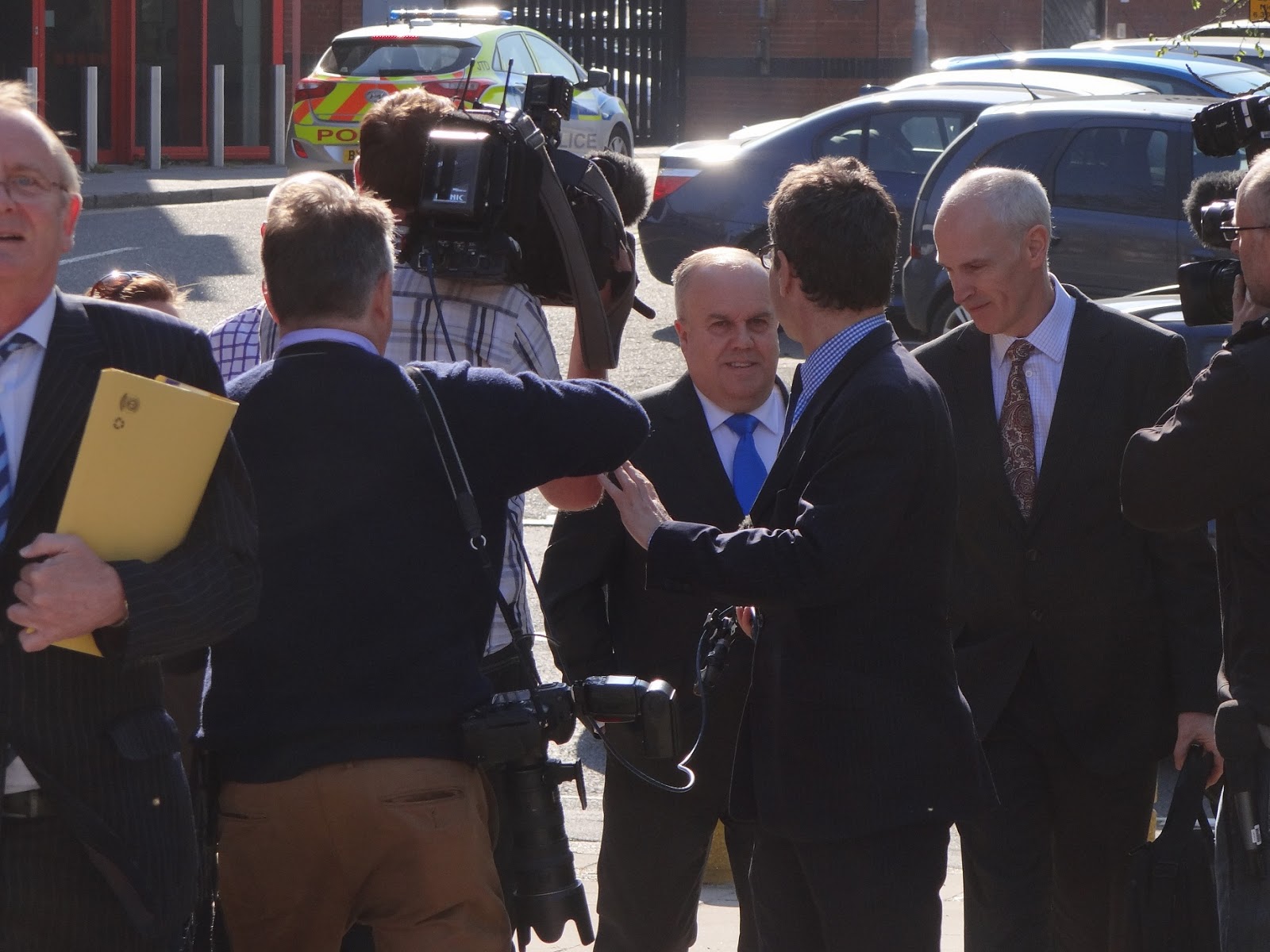
Mrs Angry and the Barnet Bugle turned up just as the court opened, first to arrive other than a group of cameramen and photographers waiting to catch Councillor Coleman's appearance.

We gave our details, and were given details of the case, Judge Deborah Wright, counsel for the prosecution Manjit Mahal, for the defence, Neville Rudston. 

Coleman arrives at Uxbridge Magistrates' Court with his solicitor

Brian Coleman turned the corner to the court room, saw Mrs Angry sitting waiting there, right next to the door, and appeared rather annoyed to see her, which was most amusing. 

He swept by, muttering something unintelligible, into an interview room with his legal representatives.

In court, a retinue of Barnet bloggers, and reporters from the local and national press sat in the designated seats, which were very few. In the High Court, in both cases recently attended by Mrs Angry, after sending in a card and asking permission there was no problem about sitting in court, or tweeting, or indeed in the facilities for the public. In this small town court, it was very different: Mrs Angry left the well of the court twice, once voluntarily when a young local reporter, turning up late, had a tantrum and wanted her seat, second time after Brian Coleman, via his counsel,  made the usher publicly eject her: on asking why, he said there had been 'a complaint'. 

From whom, demanded Mrs Angry, across the court ... ? The usher pointed at Coleman's solicitor. Mrs Angry laughed. Typical Coleman, more worried about the proximity of his old adversary, than the fact he was about to stand in the dock accused of beating a woman in the street.

The public gallery was sealed off from the court by a glass screen, giving the impression of a large number of badly organised and rather eccentric mafiosi sent to trial for money laundering, or perhaps, bearing in mind we were in Uxbridge, circa 1932,  failing to return some slightly overdue library books. 

There was no amplified sound, and little care given to the need to make the proceedings accessible, or audible. Justice, in Uxbridge, may be seen to be done, but not heard.

For Mrs Angry, who has imperfect hearing, it was something of an ordeal, but did not entirely detract from the degree of satisfaction felt at sitting behind Brian Coleman in the dock, and noting the whole of the wooden edifice which contained him, in his moment of shame, was almost completely covered in a display of scratched and semi-literate graffiti, mostly initials, but rather stupidly, in some cases, full names and dates, left by previous defendants: NEV ... DALE ... T.B. ... 

Mrs Angry checked as we left the room later that day: there appeared to be no BC 3/05/2013. But above the judge, the court's emblem loomed large, and reminded us of the principles of British justice: Honi Soit, Qui Mal Y Pense, and Dieu et Mon Droit. The hearing began.

Coleman stood in the dock and gave his name and date of birth. He declined, however, to give his address. The reasons for this were not given in any detail. Mrs Angry imagined that he was worried about queues of admiring residents wishing to call round and visit him with bouquets of flowers, boxes of chocolates, and fulsome expressions of grateful thanks for all his stirling efforts on their behalf, over the years. 

The judge was not impressed by the defendant's wish to guard his privacy however, and ordered him to give the details - in Essex Park, Finchley, where, despite his formerly handsomely paid posts paid for by the public purse - his income was around £130,000 per year - he has lived for many years in a charity owned flat, at a fixed rate rent.

There were some long and mysterious adjournments before the case began properly, during the course of which it became apparent that some discussions were taking place between both the defendant's and the complainant's team. The result was that at the last moment, Coleman decided to change his plea to guilty on the the charge of common assault by beating, and the motoring charge was dropped. 

It was a highly significant admission, of course.

The website for Coleman's barrister, Neville Rudston, informs us:

"He is an experienced criminal barrister who has represented clients in matters including murder, rape and other serious sexual offences, kidnap, assault occasioning grievous bodily harm with intent, armed robbery, serious fraud and the commercial supply of class A drugs".

It also says: 

"He has appeared in matters in the Court of Appeal and the High Court and has successfully availed clients of a wide variety of defences including duress, necessity and abuse of process, often in the face of apparently overwhelming evidence ..."

Interesting, in this context, perhaps, that our Councillor Coleman was encouraged by the same counsel to plead guilty to the charge of assault. But guilty is what he stated himself to be, in the dock of Uxbridge Magistrates' Court.

After the plea, we were told the facts of the case: that he had parked illegally in a loading bay in the high street in North Finchley - an area where even today, a disproportionate number of traffic wardens prowl looking for hapless residents who have tried to visit their local shops and may have made some error in paying for the privilege of parking. 

There is the largest contingency of traffic wardens in the borough here, concentrated for some reason particularly outside Cafe Buzz, run by anti parking policy campaigner Helen Michael.
 
And for some reason, on the 20th September, Brian Coleman decided to ignore the parking restrictions in North Finchley, which apply to everyone but him, and to park where he wanted, in a loading bay outside the HSBC bank while he visited the cash machine, just along the road. Why this bank, next door to Cafe Buzz, rather than any other bank in Broken Barnet, we do not know.

He was visiting the bank, he claimed, because a young man named Tom had been doing some 'odd jobs' for him, and Tom needed paying in cash.

Helen Michael, the owner of Cafe Buzz,  had appeared with her phone, and proceeded to film or photograph him. He had grabbed her arm and her breast, in order to prevent her from doing so, and returned to his car. He had eventually reported voluntarily to Barnet Police Station, an hour after the incident, and the next day, under questioning, had been shown stills of the CCTV which had recorded the incident, which clearly showed Coleman lunging towards Ms Michael. 

Coleman had kept changing his version of events, and when asked about how the injuries to her wrist and the scratches she had had been sustained, could not explain it. An officer had pointed out that Councillor Coleman had long nails. He denied any allegations but today had changed his plea. The prosecution wanted costs, compensation, and a discussion over a potential restraining order.

Coleman referred to 'a campaign of harrassment' and his counsel pointed out that he was of 'previous good character' - the incident had happened in a moment of 'anguish', following 'a lengthy campaign'.  He had now studied the CCTV footage and could add very little. It had been 'a very fast moving event'. Your analysis, it was suggested, was as good as his.

Mmm.

The court now watched footage from the CCTV recording. 


Although seen from a distance, the film was compelling viewing. We all sat in silence, watching the figure of Brian Coleman approach the cash machine, Helen Michael come out of her cafe and film him from a distance, and then, the lunge he made at her, at some speed, and the prolonged tussle, or rather attack, which ensued. People in the public gallery gasped. Monster! yelled one woman. It was truly a shocking sight. 

Mrs Angry reflected on yet another curious example of the peculiar energy which runs through this part of Broken Barnet, along the suburban High Road that once led people to Finchley Common, a notorious area where ruthless highwaymen laid in wait and innocent travellers went in fear of their lives. Centuries later, this territory is still a place of danger, an interface of conflict, a gaping faultline where it all falls apart, sooner or later.

In mitigation, it was stated that Coleman was of previously good character. This was met with some derision from the public gallery. He had devoted his life, we were told, to public service. You can imagine the reaction to that.

'Do I gather', asked the judge drily, 'that the people in the public gallery are not supporters?'

There was, as you might expect, a certain amount of enthusiastic response to that suggestion.

Coleman's counsel continued his attempt at mitigation. The incident had taken place on 'a street where he knows he is hated'. There had been a campaign directed at him: some of done 'very very improperly'. Mrs Angry dabbed at her eyes with a tissue, deeply moved.


Mention was made of all Coleman's former positions on the GLA, fire authority, etc etc. He looked on from the dock, bristling with self importance, not realising that it appeared all the more awful that someone who had been entrusted with such responsibilities had behaved in such a manner. In fact the most telling act of the day was this: he abruptly interrupted his own counsel to interject an ill timed reminder that he had forgotten to say he had been Mayor of Barnet. 

In Coleman's pathetic distortion of suburban values, rooted in a past that never was, with authority bestowed by a chain of office, and all the pantomime of municipal ceremony, this achievement above all else is the one whose memory he treasures, representing something to him we can only guess at: a vindication, a mark of status in his home territory: an acceptance by an establishment only he feels the need from which to demand endorsement. This world he lives in no longer exists, if it ever did, and travelling back into the heart of Metroland to find justice proved to be a fool's errand.

Apart from trying to blame his violent assault on a campaign directed on him, Coleman tried once more to claim that his octogenarian mother had as a result been the victim of an unspecified assault as a result: this claim is one he has trotted out before, in different circumstances, in a defamatory post on his ludiocrous blog, in which he blamed local bloggers for 'bizarre activities' including an attack in the street on his then 88 year old mother. 

We were invited then to feel sorry for his misfortunes: losing his seat on the Assembly, being now on ' a very limited income', personal difficulties for which the complainant, ie Ms Michael, claimed the credit. 

Mrs Angry was again moved to tears, especially when we were asked to imagine the anguish felt by the defendant, after months of stress, which had driven him to act 'instinctively' in his attack, and now, we were told, many people were going to go away and celebrate his moment of shame - not something most people have to bear. Oh dear, thought Mrs Angry, suddenly overcome with remorse. 

Alright, no: not so much remorse, in fact, as the knowledge of justice done, immense satisfaction,  a feeling of righteousness, and a sense of triumph, the triumph of virtue, at last, here in Broken Barnet.

Judge Wright gave her summing up. It was fair, balanced, and well measured. She stated that in her view, the motive for Coleman's assault was 'to avoid the embarrassment of the publicity of his visit and the parking arrangements he made that day'. As a result of the attack, 'Ms Michael sustained a number of injuries, including scratches to her hands and wrist, soreness to the wrist, her shoulder and in the region of her chest'.

Coleman was fined a total of around £1400, including costs, and compensation to Helen Michael. His counsel asked for 28 days in which the sum should be paid. Coleman was said to earn only around £200 a week, the basis for his fine.

As we left the court, Coleman rushed out, and a member of the public yelled something about his now being a convicted criminal. Helen stood and took questions from the media. She said she was delighted that justice had been served, that Coleman's career was effectively finished, and that 'he had picked on the wrong woman this time'. 

Smiles all round: Helen Michael speaks to BBC London

The experience leading up to the trial had been, she commented ruefully, 'an interesting journey'. She thought that his lying and bullying behaviour meant he was not fit for public office, and that he had 'a problem with women', that people had come to the court that day because they felt he had abused them too.

Outside the court, reporters and cameras crews were waiting for Helen to emerge. She gave interviews to the BBC and ITN, and was her usual articulate, intelligent, courageous self, as you can see from the footage above - which includes a contribution outside court from a woman also known as Mrs Angry. 

Mrs Angry's alter ego, Theresa Musgrove, interviewed by ITN

Immediately after the incident had happened last September, Mrs Angry went to see Helen. She was sitting in her cafe, clearly suffering the after effects of shock: pale, shaking, and simply stunned by what had happened, as indeed were we all. On her arm the marks of her attack were clearly visible.  

Helen Michael is a small woman, of very slight build, and no match for the brute force of a man intent on assaulting her: physically, that is. But she was determined to see Coleman brought to justice, and the police response was instant, and highly supportive. While we were at the cafe news came that he had been arrested, and then detained in a police station: he spent that night in the cells, the thought of which brought no little satisfaction to many of us here, in Broken Barnet.

The months leading up to this trial have put Helen under an almost intolerable burden of stress and anxiety. Apart from struggling to keep her business afloat in the aftermath of Brian Coleman's disastrous parking policy in action, she has been the victim of an horrendous assault, been subjected to a lengthy process leading up to the prosecution, and then an appearance in court. Her powers of endurance, and determination to see justice done, have been outstanding: she is truly a remarkable woman: bright, positive, hard working, full of energy - and very funny. She is also extremely brave.

Throughout this period she has also had to come to terms with the serious illness of her mother, who is now gravely ill, and indeed in the last week Helen has been spending much of her time at the local hospice where her mother is being cared for. She is donating the compensation awarded by the judge from Coleman to the Marie Curie Nurses Fund.


After the assault of Helen Michael took place, Coleman's fellow Tories in Barnet closed ranks, and refused to condemn his actions. Leader Richard Cornelius stood by him, saying he liked Brian, and anyway he was innocent until proven guilty, and that to comment further might prejudice his trial. Quite incredibly, the local Conservative Association did not suspend Coleman, and it was left to the intervention and insistence of the central party to force such a move.

Before the trial, it was clear that misinformation was being spread about the incident. Barnet Tory councillors believed that Ms Michael had in some way set up the assault, that Coleman was the victim of a conspiracy: a story in the Evening Standard here included a suggestion from 'friends of Coleman' that Helen had left him 'scratched and bleeding'. 

Even as late as the morning of the trial, a local reporter told Mrs Angry, shrugging, that Coleman would get off, that he had been told the incident was 'six of one, half a dozen of the other'. That all this was a complete lie was clearly demonstrated in court when the footage of the attack was shown.

What happened was that a woman was attacked and beaten in the street, in full view of witnesses, and a CCTV camera, by a man raging with fury that anyone would dare to hold him to account for his hypocrisy in flouting the injust rules which he had imposed on others.  

Since the conviction, no Tory councillor has commented on the matter. 

Barnet Council has stated there is no need for comment as  Coleman was not on council business when the assault took place.

The silence from both local Conservatives and the local authority is simply indefensible.

A proven act of violence against a woman is being ignored, and dismissed as of no consequence. 

Such an act by any man against a woman is always unacceptable, but when it is made by an elected representative of the community, one who boasts of his long record in public office, and indeed is still here, in this community, a councillor and actively involved in various local bodies, this is even more abhorrant. 

A councillor's behaviour when not on council business most certainly is a matter for the local authority and for the local Tory party to which he belonged, particularly in these shameful circumstances. 

To say otherwise sends a clear message that an assault of this nature is trivial, and that the violent abuse of women is of no consequence - this is clearly utterly unacceptable.

There is a deep rooted misogyny within the heart of Barnet Tories: the party here is dominated, as we have often commented, by a culture that is exclusive of women, marked by an absence of female councillors other than those who are dutiful wives of other councillors, or unthreatening in their submission to the culture of bullying which permeates their group. 

Remember the night in 2010, when Councillor Kate Salinger, the only Tory who dared abstain from supporting the vote for an enormous rise in their allowances, was forced to watch as her colleagues, instructed by the whip Brian Coleman, immediately and publicly remove her, one by one, from every council post she held? Afterwards, Coleman commented smugly to the press as she left the town hall in tears: that's discipline for you.

Remember the other night in the Town Hall, where Brian Coleman, in a speech ranting in support of the One Barnet programme, which weeks later he admitted was a total disaster, abused women in the public gallery, including Mrs Angry, calling them 'sad, mad, and a couple of old hags'? His Tory colleagues laughed, and the Mayor refused to force him to apologise. 

The fear and loathing of women felt by Coleman and his colleagues is a demonstration of their own personal inadequacies, and aggravated by one unpalatable truth: the most effective opposition to their reign of tyranny and incompetence has been instigated and galvanised by women. We have been their undoing: not by any other means other than outwitting them, and holding up a mirror to their ugly, threatening faces. The mirror has cracked, from side to side, and Broken Barnet lies in pieces.

Brian Coleman is the true face, the animus of the Tory party in Barnet, and his repellant behaviour is the nothing less than the active representation of their collective psyche. 

Coleman has disgraced himself, his office, and his party. 

He has been exposed as a liar, and a bully, and he has no place in politics, or public life. But he is the past, and now we look to the future, and to the battle to cleanse this borough of the Tory administration which made him, supported him, and continues to support his policies and his attitudes: continues to demonstrate nothing but contempt for the people who elected them, and an absolute refusal to listen to their views, or to engage in the democratic process.

The assault of Helen Michael: the grotesque struggle and assault which took place is an apt analogy of the struggle between the will of the people of this borough and the Tory administration which seeks to keep us in check.

We will not be kept in check, and we will fight back, and we are fighting back, through the processes of justice, until we regain our freedom, and control over our own future.

Updated: Monday 7th May

An open letter to Richard Cornelius, Conservative leader of Barnet Council.


On Friday 3 May Councillor Brian Coleman pleaded guilty to the charge of common assault by beating of Helen Michael, in the High Road in North Finchley. Evidence from CCTV was shown in court and proved incontrovertibly that this incident was nothing less than an utterly indefensible act of aggression. It resulted from Councillor Coleman being caught parking in a loading bay, trying to evade the hugely controversial parking payment scheme he had imposed on residents in this borough.

Despite the fact that he has now been convicted of a criminal act of assault, Barnet Council has refused to comment, absurdly claiming that this is unnecessary as the attack did not take place while the Councillor was on council business.

Indeed local Tory members, including leader Richard Cornelius, openly continued to support their fellow member after he was charged, and were privately informing others that the story of the assault was false.Councillor Coleman was suspended from the party only after intervention from Conservative Central Office. Since the conviction, local Conservatives have issued no statement.


By his own actions Councillor Coleman has shown himself to be unfit for public office: such bullying behaviour, dishonesty and hypocrisy are not acceptable in an elected representative of the community. We demand therefore that he stand down from his seat in Totteridge, and that the Conservative Party expel him from membership.

We call on Richard Cornelius, as leader of Barnet Council, and on behalf of the Conservative Party in this borough, to apologise to Ms Michael, and to dissociate himself and his colleagues from this appalling incident. 
To remain silent is not an option: to remain silent is to condone an act of violence against a woman, and this was and must always be absolutely unacceptable.

Signed:
Derek Dishman
John Dix
Vicki Morris
Theresa Musgrove
Roger Tichborne